


Reviewed by Russell Noga, Licensed Insurance Agent · Updated November 19, 2026
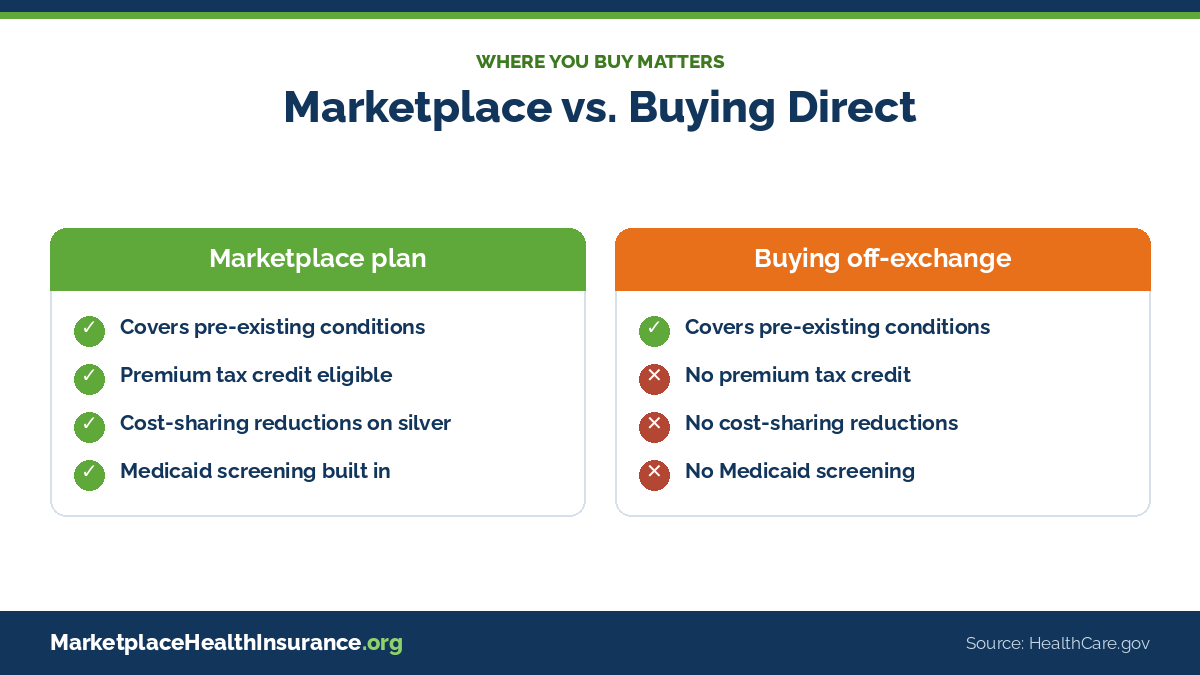
The health insurance marketplace 2027 is where individuals and families who do not get coverage through a job, Medicare or Medicaid can buy a plan that follows Affordable Care Act rules. Every Marketplace plan covers pre-existing conditions and the essential health benefits, and it is the only place to get a premium tax credit that lowers your monthly bill.
2027 plans are live
See Marketplace Plans in Your ZIP Code
Compare premiums, deductibles and networks from the insurers in your area, with your estimated savings.
Plans, prices and savings vary by ZIP code, age, household size and income.
This guide explains how the Marketplace works for 2027, who can use it, how plans and savings are structured, what changed this year, and how to enroll before the deadline. When you are ready to shop, you can compare Marketplace health insurance plans by ZIP code.
The short answer
The health insurance marketplace sells ACA-compliant individual and family plans through HealthCare.gov or your state’s own exchange. Open enrollment for 2027 coverage runs November 1, 2026 to January 15, 2027 in HealthCare.gov states; pick a plan by December 15, 2026 for a January 1 start. Tax credits are available from 100% to 400% of the federal poverty level.
How the Health Insurance Marketplace Works
The Marketplace, also called the exchange, is a shopping and enrollment system created by the Affordable Care Act. Private insurance companies sell the plans, but the Marketplace sets the rules, checks your eligibility for savings and sends your premium tax credit straight to the insurer so your monthly bill is lower.
Guaranteed coverage
Plans cannot turn you down or charge more because of a pre-existing condition.
Essential health benefits
Every plan covers core services such as hospital care, prescriptions, maternity care, mental health and preventive care.
Income-based savings
Premium tax credits and cost-sharing reductions are available only on Marketplace plans.
Yearly out-of-pocket cap
Each plan has a maximum you pay for covered in-network care in a year.
Most states use the federal platform, HealthCare.gov. About 20 states and the District of Columbia run their own exchanges, such as Covered California and NY State of Health. The rules are similar, but deadlines and extra state help can differ.
Who Can Buy a Marketplace Plan for 2027
- Residency: you must live in the state where you apply.
- Citizenship or lawful presence: U.S. citizens and lawfully present immigrants can buy coverage. Starting in 2027, tax credits for non-citizens are limited to lawful permanent residents, Cuban/Haitian entrants and COFA residents; refugees and asylees can buy a plan but without a tax credit.
- Not on Medicare: people enrolled in Medicare generally cannot use the Marketplace.
- Job-based coverage: you can buy a Marketplace plan, but you usually cannot get a tax credit if your employer offers affordable coverage.
- Medicaid work requirements: starting in 2027, people denied or removed from Medicaid solely for not meeting work requirements are not eligible for premium tax credits.
Income determines what help you get. See our Obamacare income limits for 2027 guide to check where your household falls.
Metal Levels and Plan Types
| Metal level | Plan pays on average | Best for |
|---|---|---|
| Bronze | About 60% | Healthy people who mainly want protection from big bills |
| Silver | About 70% | People who qualify for cost-sharing reductions |
| Gold | About 80% | People who expect regular doctor visits or prescriptions |
| Platinum | About 90% | Heavy users of care, where offered |
| Catastrophic | Very high deductible | Under 30 or with a hardship exemption |
Percentages are the average share of covered costs a plan pays for a typical population; your costs depend on the care you use.
Plans also differ by network type. HMOs and EPOs usually limit you to a set network, while PPOs may pay something for out-of-network care. Always check that your doctors and prescriptions are covered before you choose.
What Changed in the Marketplace for 2027
2027 Marketplace in numbers
+13%
Average benchmark silver premium change
$703
National average benchmark silver, 40-year-old, per month
400% FPL
Tax credit income cap returns
13.1M
CBO projected 2027 Marketplace enrollment
- Enhanced tax credits expired. The extra help available from 2021 through 2025 ended, so original ACA rules apply again.
- Premiums rose again. The average benchmark silver premium went up 13% for 2027 after rising about 26% for 2026.
- No repayment cap. Starting with the 2026 tax year, all excess advance tax credit must be repaid.
- Insurer changes. Cigna is leaving the individual market in all 11 of its states, and other carriers exited or entered specific states.
For state-by-state price changes, see our guide to the health insurance premium increase 2027 by state.

From the agent’s desk
The most expensive Marketplace mistake in 2027 is letting a plan renew without checking it. With premiums up again and the enhanced credits gone, the renewed plan can cost noticeably more, while a similar plan from another insurer may cost less. A side-by-side comparison of three plans usually takes under an hour.
Russell Noga, Licensed Insurance Agent
Savings: Premium Tax Credits and Cost-Sharing Reductions
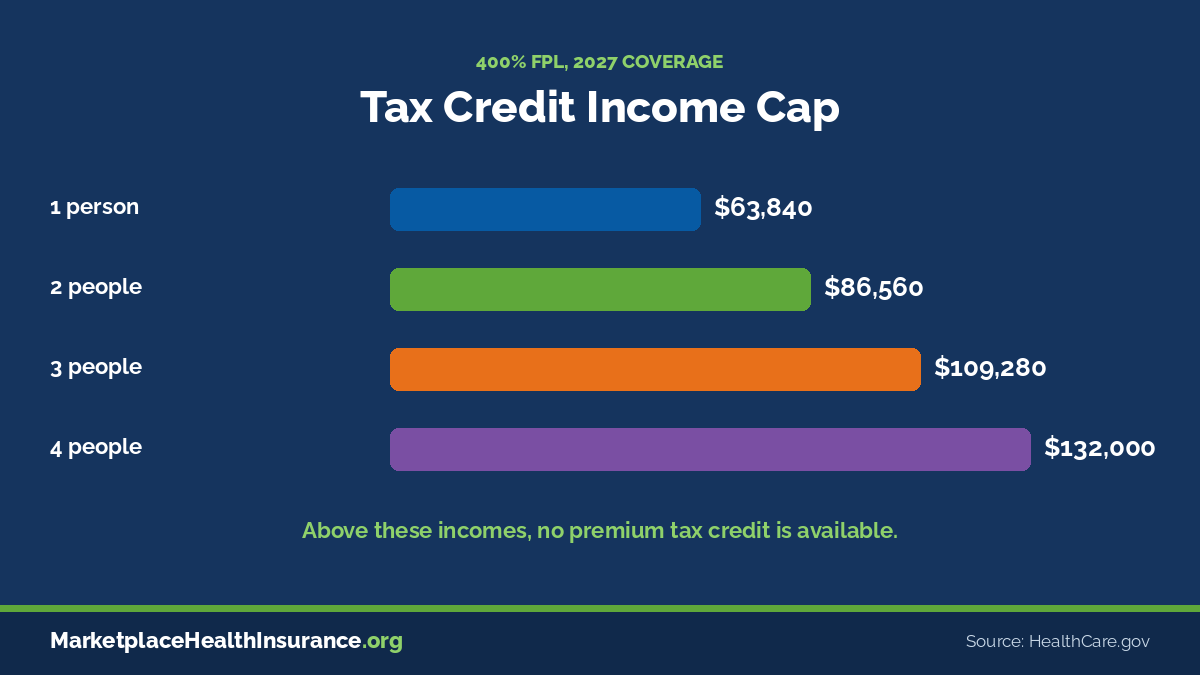
For 2027 coverage, premium tax credits are available to households with income from 100% to 400% of the federal poverty level. Above 400%, there is no tax credit. In states that expanded Medicaid, adults below 138% FPL usually qualify for Medicaid instead. Our Obamacare subsidies for 2027 guide explains how the credit is calculated.
| Household size | 100% FPL | 400% FPL |
|---|---|---|
| 1 | $15,960 | $63,840 |
| 2 | $21,640 | $86,560 |
| 3 | $27,320 | $109,280 |
| 4 | $33,000 | $132,000 |
2026 poverty guidelines used for 2027 coverage in the 48 contiguous states and DC; Alaska and Hawaii are higher.
Silver plans can be worth more
If your income is at or below 250% of the federal poverty level, about $39,900 for one person, a silver plan may come with lower deductibles and copays through cost-sharing reductions. That help is available only on silver plans.
Several states add their own help for 2027. New Mexico fully replaces the lost federal enhanced credits, California expanded partial help for incomes from 165% to 200% FPL, New Jersey keeps its program, and Rhode Island and Virginia created new state subsidies.
2027 Marketplace Plans
Call a Licensed Agent Now
A licensed agent can compare 2027 Marketplace plans in your ZIP code and check your premium tax credit at no cost.
TTY 711 · Mon–Fri 8am–8pm ET · No obligation to enroll
Open Enrollment 2027 Dates and How to Enroll
1
Find your exchange. Enter your ZIP code to see whether you use HealthCare.gov or a state exchange.
2
Gather household details. Have Social Security numbers, income estimates and current coverage information for everyone applying.
3
Estimate 2027 income. Your tax credit is based on expected 2027 income, not last year’s return.
4
Compare plans by total cost. Add 12 months of premium to the deductible you could realistically reach.
5
Pick a plan by December 15, 2026. That gives a January 1, 2027 start in HealthCare.gov states. Plans picked December 16 through January 15 start February 1.
6
Pay the first premium. Coverage starts only after the insurer receives your first payment.
Some state exchanges stay open longer, including until January 31, 2027 in California, New Jersey, New York, Rhode Island and DC. See our Marketplace open enrollment guide for every date, or follow our step-by-step guide on how to apply for Obamacare 2027. Outside open enrollment, you need a qualifying life event such as losing coverage, moving or having a baby, which usually opens a 60-day Special Enrollment Period.
Choosing an Insurance Company
The insurers available to you depend on your county. Large national carriers, regional Blue plans and local health systems all sell on the Marketplace, and the lineup changes every year. Our Marketplace health insurance companies guide profiles the main carriers, and our state guides list the local options and deadlines for each state.
Before you enroll
- ✔Review your renewal notice if you had a 2026 plan.
- ✔Update household size and 2027 income.
- ✔Confirm doctors, hospitals and prescriptions.
- ✔Compare total yearly cost, not just the premium.
- ✔Check whether a silver plan with extra savings fits.
- ✔Choose by December 15, 2026 for January 1 coverage.
For more coverage topics, browse our health insurance guides.
Deadline December 15
Start Your 2027 Coverage on January 1
Enter your ZIP code to compare plans and see your premium tax credit estimate.
Plans, prices and savings vary by ZIP code, age, household size and income.
Health Insurance Marketplace 2027 FAQs
➤ What is the health insurance marketplace?
It is the exchange created by the Affordable Care Act where individuals and families buy ACA-compliant health plans and apply for premium tax credits. Most states use HealthCare.gov; some run their own exchanges.
➤ When can I enroll in a Marketplace plan for 2027?
Open enrollment runs November 1, 2026 to January 15, 2027 in HealthCare.gov states. Choose by December 15, 2026 for coverage starting January 1, 2027.
➤ Who qualifies for Marketplace subsidies in 2027?
Households with income from 100% to 400% of the federal poverty level, such as $15,960 to $63,840 for one person, who lack affordable job-based coverage and meet citizenship or immigration rules.
➤ Why are Marketplace premiums higher for 2027?
The average benchmark silver premium rose 13% for 2027, driven by rising medical prices, inflation, the expiration of the enhanced premium tax credits and a sicker risk pool.
➤ Can I buy a Marketplace plan outside open enrollment?
Only with a qualifying life event, such as losing other coverage, moving, marriage or having a baby. You usually have 60 days to enroll.
➤ Do Marketplace plans cover pre-existing conditions?
Yes. All Marketplace plans must cover pre-existing conditions and the essential health benefits.
➤ Which metal level should I choose?
It depends on how much care you expect to use and your income. Silver plans are the only ones with cost-sharing reductions for incomes up to 250% FPL.
Free Plan Comparison
Call a Licensed Agent Now
Compare 2027 Marketplace plans and savings with a licensed agent in one call.
TTY 711 · Mon–Fri 8am–8pm ET · No obligation to enroll
About the Author: Russell Noga
Russell Noga is a licensed insurance agent and the founder of ZRN Health & Financial Services, LLC. He has helped people compare health and supplemental insurance for more than 16 years and reviews every page on MarketplaceHealthInsurance.org before it is published.
MarketplaceHealthInsurance.org is privately owned and operated by ZRN Health & Financial Services, LLC, based in Austin, Texas. We are not HealthCare.gov or any state exchange and are not connected with or endorsed by any government agency. Premiums, subsidies and plan availability vary by state, ZIP code, age, household size and income. Calls may be answered by a licensed insurance agent from a partner agency.