


Reviewed by Russell Noga, Licensed Insurance Agent · Updated November 19, 2026
Knowing how to apply for Obamacare 2027 coverage saves time and money, because the application decides both which plans you see and how much premium tax credit you get. The process is the same whether you apply on HealthCare.gov, through a state exchange, by phone or with a licensed agent: you answer questions about your household and income, the marketplace checks your eligibility, and then you choose a plan.
Open enrollment is on now
Check 2027 Obamacare Plans Before You Apply
Enter your ZIP code to preview premiums, deductibles and estimated tax credits from the insurers in your area.
Plans, prices and savings vary by ZIP code, age, household size and income.
This guide walks through each step in order, lists the documents to have on hand and points out the mistakes that cost people money at tax time. If you want to skip ahead, you can compare 2027 Marketplace plans by ZIP code and see estimated savings before you start a full application.
The short answer
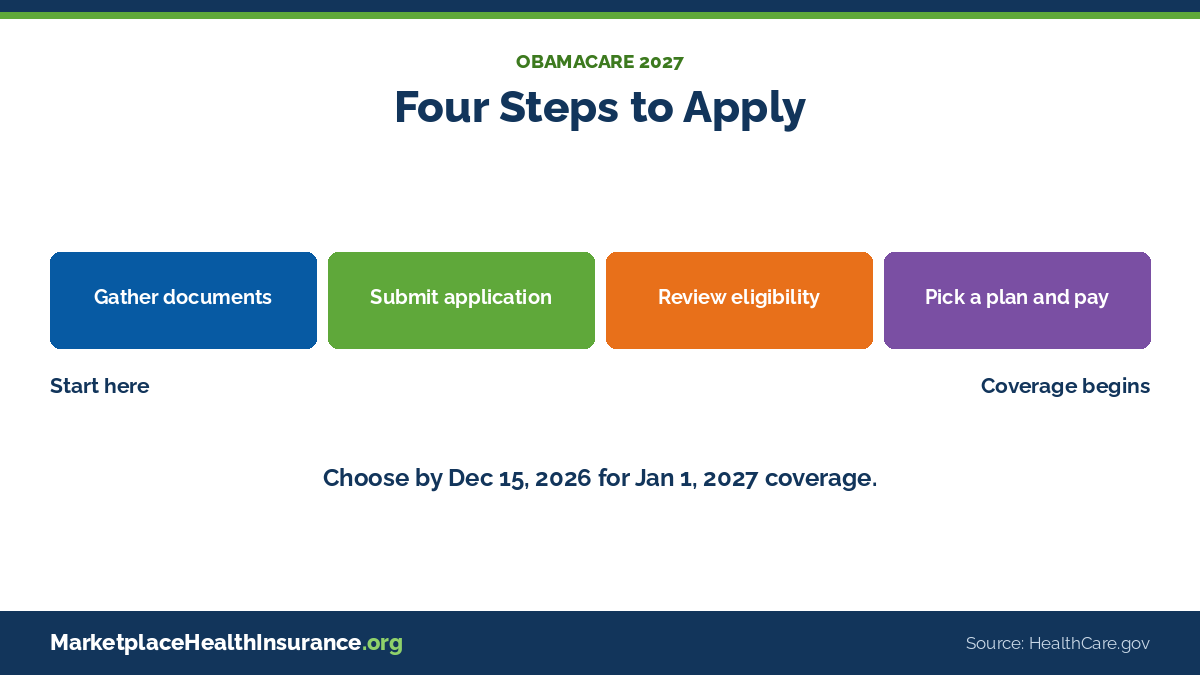
To apply for Obamacare for 2027, gather Social Security numbers and income details for your household, create an account on HealthCare.gov or your state exchange, complete the application, review your eligibility results, then pick a plan by December 15, 2026 for January 1 coverage or by January 15, 2027 for February 1 coverage.
Who Can Apply for Obamacare in 2027
Obamacare is the common name for coverage sold through the Affordable Care Act health insurance marketplace. Anyone who lives in the United States, is a U.S. citizen or lawfully present, and is not in prison can buy a plan. Qualifying for financial help is a separate question with stricter rules.
Can buy a plan
U.S. citizens and lawfully present residents who live in the state where they apply, including people with pre-existing conditions.
Can get a tax credit
Households with income from 100% to 400% of the federal poverty level who lack affordable job-based coverage, Medicare or Medicaid.
Usually not eligible
People enrolled in Medicare, people with an affordable employer plan, and people who qualify for Medicaid or CHIP.
New limits for 2027
Tax credits are limited to certain immigration categories, and people removed from Medicaid only for work requirements cannot get them.
For 2027, premium tax credits go to lawful permanent residents, Cuban and Haitian entrants and residents under the Compacts of Free Association. Refugees and asylees can still buy a plan but do not receive the tax credit. If you are unsure which group you fall into, the application will ask and give you a result.
Documents to Gather Before You Apply
Having your paperwork ready turns a long session into a short one. The application asks about everyone in your tax household, including people who are not applying for coverage.
Your 2027 application checklist
- ✔Social Security numbers (or document numbers for lawfully present immigrants) for everyone applying.
- ✔Birth dates and home address, plus a mailing address if different.
- ✔Recent pay stubs, W-2s or a profit-and-loss summary if you are self-employed.
- ✔Your best estimate of 2027 household income, not just last year’s tax return.
- ✔Information about any job-based coverage offered to anyone in the household, even if you turned it down.
- ✔Policy numbers for any current health coverage.
- ✔A list of doctors and prescriptions you want covered.
Employer coverage questions
If an employer offers you or a family member a plan, you will need the cost of the lowest-priced employee-only option. An affordable offer can make you ineligible for a tax credit, so ask the employer’s benefits office for this number before you apply.
How to Apply for Obamacare 2027, Step by Step
1
Choose where to apply. Use HealthCare.gov if your state uses the federal exchange, or your state’s own exchange if it runs one. You can also apply by phone or with a licensed agent at no extra cost.
2
Create or log in to your account. Returning customers should log in to the existing account so the 2026 plan and history carry over.
3
Fill out the household section. List everyone you claim on your taxes, even those who do not need coverage, because household size sets your poverty-level percentage.
4
Enter your 2027 income estimate. Include wages, self-employment income, Social Security and other taxable income for each adult.
5
Submit and read your eligibility notice. It shows your premium tax credit, whether you qualify for cost-sharing reductions, or whether you may qualify for Medicaid or CHIP instead.
6
Compare plans and enroll. Filter by metal level, network and total yearly cost, then select a plan before the deadline.
7
Pay the first premium. Coverage does not start until the insurance company receives your first payment.
Most people finish in under an hour when their documents are ready. If the marketplace needs proof of income or citizenship, it will send a data-matching notice with a deadline to upload documents, usually 90 days. Respond on time so your tax credit is not removed.
2027 Marketplace Plans
Call a Licensed Agent Now
A licensed agent can compare 2027 Marketplace plans in your ZIP code and check your premium tax credit at no cost.
TTY 711 · Mon–Fri 8am–8pm ET · No obligation to enroll
2027 Deadlines That Control Your Start Date
Open enrollment for 2027 coverage runs from November 1, 2026 through January 15, 2027 on HealthCare.gov. A federal rule that would have shortened the period was vacated in court, so the standard dates apply. Full details are in our Marketplace open enrollment guide.
| If you pick a plan by | Coverage begins |
|---|---|
| December 15, 2026 | January 1, 2027 |
| January 15, 2027 | February 1, 2027 |
| After January 15, 2027 | Only with a Special Enrollment Period |
HealthCare.gov states. Some state exchanges stay open later, including California, New Jersey, New York, Rhode Island and DC (January 31, 2027). Idaho closes December 15, 2026.
Outside open enrollment you need a qualifying life event, such as losing other coverage, marriage, a new baby or a move. You usually have 60 days from the event to apply.
How Your Income Estimate Sets Your Savings
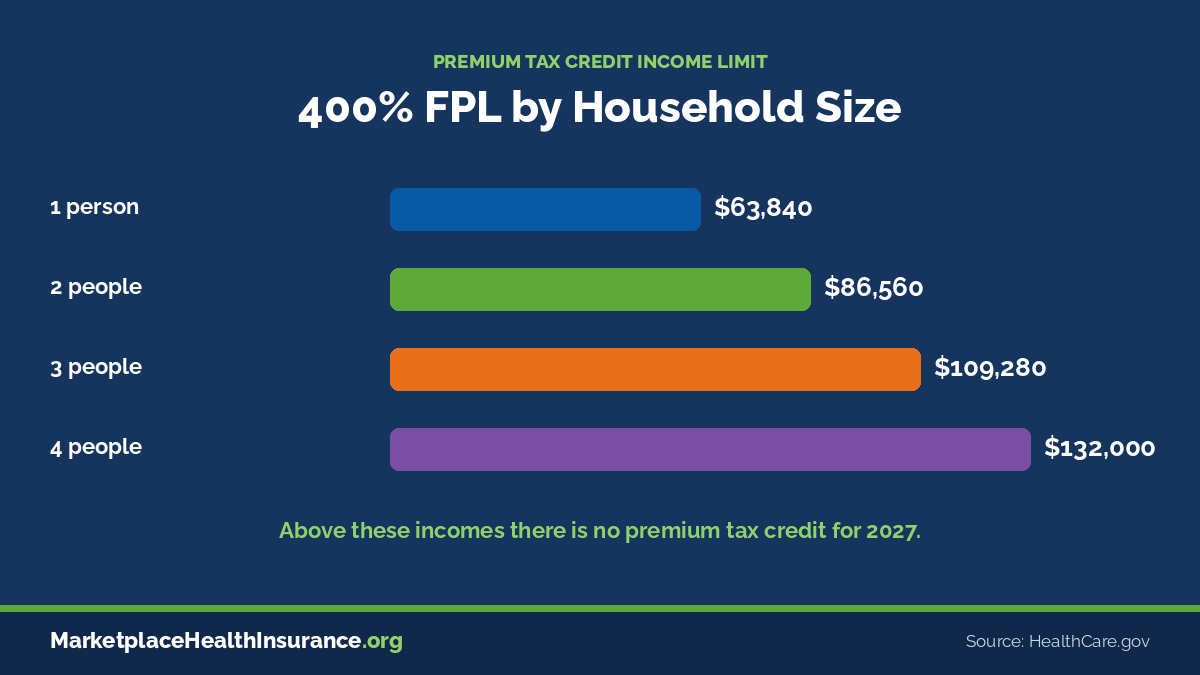
The enhanced premium tax credits that applied through 2025 have expired, so the original ACA rules are back for 2027. Help is available from 100% to 400% of the federal poverty level, and the amount shrinks as income rises. Above 400% there is no tax credit at all.
| Household size | 100% FPL | 250% FPL (silver extra savings) | 400% FPL (tax credit limit) |
|---|---|---|---|
| 1 | $15,960 | $39,900 | $63,840 |
| 2 | $21,640 | $54,100 | $86,560 |
| 3 | $27,320 | $68,300 | $109,280 |
| 4 | $33,000 | $82,500 | $132,000 |
2026 federal poverty guidelines, used for 2027 coverage in the 48 contiguous states and DC. Alaska and Hawaii are higher.
Repayment caps are gone
Starting with the 2026 tax year there is no cap on paying back excess premium tax credit. If your 2027 income ends up higher than you estimated, you could owe the full difference when you file. Report income changes to the marketplace during the year.

From the agent’s desk
The income estimate is the line that causes the most trouble. Self-employed applicants and anyone expecting a raise should build the estimate from expected 2027 earnings and update it during the year, since excess tax credit must now be repaid in full at tax time.
Russell Noga, Licensed Insurance Agent
Choosing a Plan After Your Application Is Approved
Your eligibility notice opens the plan list. Plans are grouped by metal level, and every level covers the same essential health benefits. The difference is how you and the insurer split costs. Our Marketplace health insurance companies guide explains who sells where.
Lower premium plans (bronze)
✔
Smallest monthly bill after the tax credit.
✔
Can make sense if you rarely see a doctor.
✔
Still caps your yearly out-of-pocket costs.
Higher premium plans (silver, gold)
✕
Silver is the only level with cost-sharing reductions for incomes up to 250% FPL.
✕
Gold lowers deductibles if you expect regular care.
✕
Higher monthly premium if your income is above 250% FPL.
Compare total yearly cost: twelve months of premium plus the deductible you could realistically reach. Then check each plan’s provider network and drug list. For background on what every plan must cover, see what ACA insurance is.
Common Application Mistakes to Avoid
- Letting the plan renew automatically. A renewed plan can come back with a higher premium or a different network. Cigna, for example, is leaving the individual market in all 11 of its states for 2027.
- Using last year’s income. The credit is based on what you expect to earn in 2027.
- Leaving people off the household. A missing dependent changes your poverty-level percentage and your savings.
- Ignoring data-matching notices. Missing the upload deadline can end your tax credit mid-year.
- Forgetting the first payment. An unpaid first premium means the plan never starts.
If you would rather search plans before creating an account, the health insurance plan finder shows what is sold in your area.
Ready to apply?
Get Covered for 2027 Before the Deadline
Compare plans side by side and finish your enrollment with help if you need it.
Plans, prices and savings vary by ZIP code, age, household size and income.
Obamacare Application FAQs
➤ How do I apply for Obamacare for 2027?
Apply on HealthCare.gov or your state’s exchange, by phone, or with a licensed agent. You will enter household and income information, review your eligibility results and then choose a plan.
➤ When is the deadline to apply for Obamacare 2027?
On HealthCare.gov, pick a plan by December 15, 2026 for coverage starting January 1, 2027. Open enrollment ends January 15, 2027, with coverage starting February 1. Some state exchanges have later deadlines.
➤ What income qualifies for Obamacare subsidies in 2027?
Premium tax credits are available for household income from 100% to 400% of the federal poverty level. For 2027 coverage, 400% is $63,840 for one person and $132,000 for a family of four.
➤ Can I apply for Obamacare if I have a pre-existing condition?
Yes. Marketplace plans cannot deny you or charge you more because of a pre-existing condition.
➤ Do I need to reapply every year?
Returning enrollees should update their application each open enrollment. Many are renewed automatically, but updating income and comparing plans helps avoid a surprise bill or a lost tax credit.
➤ How long does the Obamacare application take?
Most people finish in under an hour with their documents ready. Coverage starts on the first of the month that matches your enrollment date once the first premium is paid.
➤ Can I apply after open enrollment ends?
Only if you have a qualifying life event such as losing coverage, getting married, having a baby or moving. You usually have 60 days from the event to apply.
Free Plan Comparison
Call a Licensed Agent Now
Compare 2027 Marketplace plans and savings with a licensed agent in one call.
TTY 711 · Mon–Fri 8am–8pm ET · No obligation to enroll
About the Author: Russell Noga
Russell Noga is a licensed insurance agent and the founder of ZRN Health & Financial Services, LLC. He has helped people compare health and supplemental insurance for more than 16 years and reviews every page on MarketplaceHealthInsurance.org before it is published.
MarketplaceHealthInsurance.org is privately owned and operated by ZRN Health & Financial Services, LLC, based in Austin, Texas. We are not HealthCare.gov or any state exchange and are not connected with or endorsed by any government agency. Premiums, subsidies and plan availability vary by state, ZIP code, age, household size and income. Calls may be answered by a licensed insurance agent from a partner agency.