


Reviewed by Russell Noga, Licensed Insurance Agent · Updated November 19, 2026
Obamacare subsidies 2027 work very differently from the last few years. The enhanced premium tax credits that capped costs for higher earners expired at the end of 2025, so the original Affordable Care Act rules are back. Help is available to households with income between 100% and 400% of the federal poverty level, and the amount depends on your income, your household size and the price of the benchmark silver plan where you live.
See your 2027 savings
Check Your 2027 Premium Tax Credit
Enter your ZIP code to see 2027 Marketplace plans with your estimated subsidy already applied.
Plans, prices and savings vary by ZIP code, age, household size and income.
This guide explains who qualifies for 2027, the exact income limits by household size, the extra help available on silver plans and the new rules that can make you pay back part of your tax credit. You can see your own estimate in a few minutes when you compare Marketplace plans in your ZIP code.
The short answer
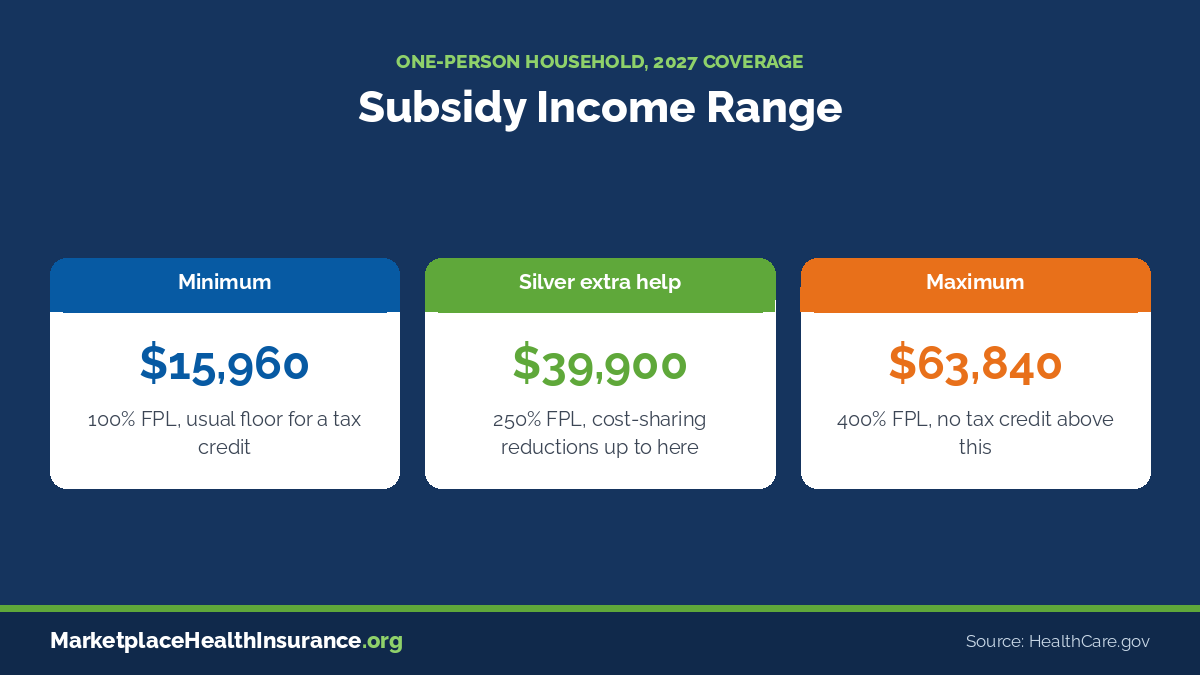
For 2027 coverage, you can get a premium tax credit if your household income is between 100% and 400% of the federal poverty level, which is $15,960 to $63,840 for one person and $33,000 to $132,000 for a family of four. Above 400% there is no premium tax credit. Below 250% you may also get lower deductibles and copays on a silver plan.
How Obamacare Subsidies Work in 2027
There are two kinds of Marketplace savings. The premium tax credit lowers your monthly premium, and cost-sharing reductions lower your deductible, copays and out-of-pocket maximum on silver plans. Both are only available on plans bought through the health insurance marketplace, either HealthCare.gov or your state’s exchange.
1
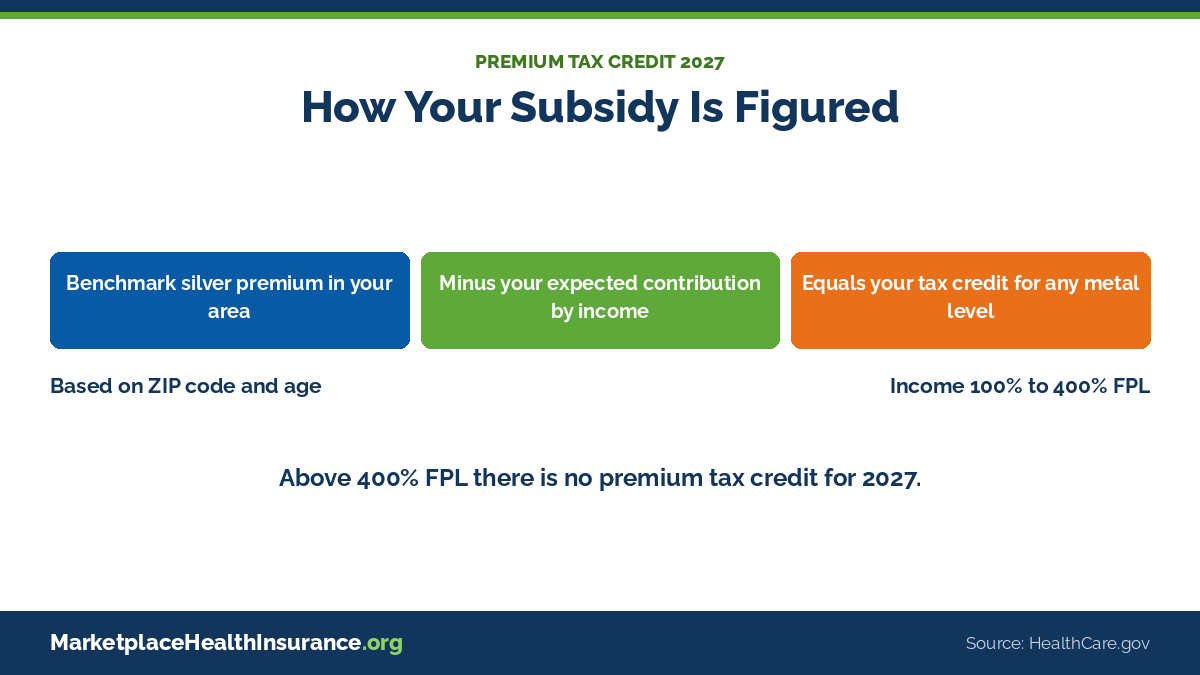
The Marketplace finds your benchmark plan. This is the second-lowest-cost silver plan available to you, based on your ZIP code, age and household.
2
It sets your expected contribution. Your income as a percentage of the federal poverty level decides how much of that benchmark premium you are expected to pay.
3
The tax credit covers the difference. The credit equals the benchmark premium minus your expected contribution. You can apply it to any metal level, not just silver.
4
You choose how to receive it. Most people take the credit in advance each month, paid straight to the insurer. You can also claim it all when you file your taxes.
Because the credit is tied to the local benchmark price, people in high-cost areas often get much larger subsidies than people with the same income in lower-cost areas.
2027 Subsidy Income Limits by Household Size
Marketplace coverage for 2027 uses the 2026 federal poverty guidelines. These figures apply in the 48 contiguous states and DC; Alaska and Hawaii have higher limits.
| Household size | 100% FPL (minimum) | 250% FPL (silver extra help) | 400% FPL (maximum) |
|---|---|---|---|
| 1 | $15,960 | $39,900 | $63,840 |
| 2 | $21,640 | $54,100 | $86,560 |
| 3 | $27,320 | $68,300 | $109,280 |
| 4 | $33,000 | $82,500 | $132,000 |
| 5 | $38,680 | $96,700 | $154,720 |
| 6 | $44,360 | $110,900 | $177,440 |
Add $5,680 to the 100% FPL figure for each additional person. Source: HealthCare.gov poverty guidelines.
In states that expanded Medicaid, adults with income up to 138% FPL (about $22,025 for one person) are usually directed to Medicaid instead of a subsidized plan. In states that did not expand, 100% FPL is generally the floor for a premium tax credit. See our guide to affordable health insurance for options if you fall below that line.
The 400% Subsidy Cliff Is Back
From 2021 through 2025, people above 400% FPL could still get help if a benchmark plan cost more than a set share of their income. That rule ended with the enhanced credits. For 2027, earning even one dollar above 400% FPL means no premium tax credit at all.
Who feels the cliff most
Older shoppers and families in high-premium areas are hit hardest, because their full-price premiums are highest. A household just above the line may pay the entire premium, while a neighbor just below it pays a capped share.
- Know where you sit. A couple at $86,000 qualifies; a couple at $87,000 does not.
- Use the right income figure. Eligibility is based on modified adjusted gross income, which starts with adjusted gross income and adds back certain items such as untaxed Social Security.
- Contributions can move you. Pre-tax retirement or HSA contributions lower adjusted gross income and can bring some households back under the limit. A tax professional can confirm what applies to you.

From the agent’s desk
The households most surprised by 2027 subsidies are those just over 400% FPL. A small change in reported income, such as a larger retirement contribution, can move a household back under the limit and restore a tax credit worth far more than the contribution itself. It is worth checking before choosing a plan.
Russell Noga, Licensed Insurance Agent
Cost-Sharing Reductions on Silver Plans
If your income is at or below 250% FPL, a silver plan can come with a built-in upgrade: lower deductibles, lower copays and a lower out-of-pocket maximum. This help is only available on silver plans, which is why the cheapest bronze plan is not always the best value for lower-income households.
Silver with cost-sharing help
✔
Lower deductible and copays
✔
Lower out-of-pocket maximum
✔
Best when you expect regular care or prescriptions
Bronze at a lower premium
✕
Higher deductible, often several thousand dollars
✕
No cost-sharing reductions
✕
Can cost more over the year if you use care
Compare the total yearly cost of each plan, not just the premium, before you decide.
2027 Marketplace Plans
Call a Licensed Agent Now
A licensed agent can compare 2027 Marketplace plans in your ZIP code and check your premium tax credit at no cost.
TTY 711 · Mon–Fri 8am–8pm ET · No obligation to enroll
New Rules That Affect Your 2027 Subsidy
No repayment cap
Starting with the 2026 tax year, there is no limit on how much excess advance premium tax credit you may have to pay back. If your income ends up higher than you estimated, the full difference can be due at tax time.
Medicaid work requirements
Starting in 2027, people denied or removed from Medicaid solely for not meeting work requirements are not eligible for a premium tax credit.
Immigration status
For 2027, premium tax credits are limited to lawful permanent residents, Cuban and Haitian entrants and COFA residents. Refugees and asylees can buy a plan but without a tax credit.
State help
New Mexico fully replaces lost federal help, California expanded partial help for 165% to 200% FPL, New Jersey keeps its program, and Rhode Island and Virginia created new state subsidies.
These changes make an accurate income estimate more important than ever. Report changes in income or household size to the Marketplace during the year so your advance credit can be adjusted.
How to Get Your Obamacare Subsidy for 2027
Before you apply
- ✔Estimate your 2027 household income, including self-employment and side work.
- ✔Count everyone in your tax household, including dependents.
- ✔Check whether anyone has an affordable offer of job-based coverage, which can block a tax credit.
- ✔Compare silver plans if your income is under 250% FPL.
- ✔Pick a plan by December 15, 2026 for coverage on January 1, 2027 in HealthCare.gov states.
- ✔Report income changes during the year to avoid a large repayment.
Open enrollment for 2027 coverage runs through January 15, 2027 in HealthCare.gov states, with later dates in some states. See the full schedule on our Marketplace open enrollment page, and learn more about the law itself in our Obamacare guide.
Open enrollment is underway
Apply Your Subsidy to a 2027 Plan
Compare premiums after savings, deductibles and networks from the insurers in your area.
Plans, prices and savings vary by ZIP code, age, household size and income.
Obamacare Subsidies 2027 FAQs
➤ Who qualifies for Obamacare subsidies in 2027?
Most people buying a Marketplace plan with household income between 100% and 400% of the federal poverty level qualify for a premium tax credit, as long as they are not eligible for Medicaid, Medicare or affordable job-based coverage.
➤ What is the income limit for Obamacare subsidies in 2027?
The upper limit is 400% FPL: $63,840 for one person, $86,560 for two, $109,280 for three and $132,000 for four, based on the 2026 poverty guidelines used for 2027 coverage.
➤ Did the enhanced Obamacare subsidies expire?
Yes. The enhanced premium tax credits ended after 2025. For 2026 and 2027, the original ACA subsidy rules apply, including the 400% FPL limit.
➤ Do I have to pay back my subsidy?
If your actual income is higher than your estimate, you may owe some or all of the extra advance credit when you file taxes. Starting with the 2026 tax year, there is no cap on that repayment.
➤ Can I use my subsidy on a gold or bronze plan?
Yes. The premium tax credit can be applied to any metal level. Cost-sharing reductions, which lower deductibles and copays, are only available on silver plans.
➤ Are there state subsidies for 2027?
Some states add their own help. For 2027, New Mexico fully backfills lost federal help, California expanded help for 165% to 200% FPL, New Jersey continues its program, and Rhode Island and Virginia created new subsidies.
Free Plan Comparison
Call a Licensed Agent Now
Compare 2027 Marketplace plans and savings with a licensed agent in one call.
TTY 711 · Mon–Fri 8am–8pm ET · No obligation to enroll
About the Author: Russell Noga
Russell Noga is a licensed insurance agent and the founder of ZRN Health & Financial Services, LLC. He has helped people compare health and supplemental insurance for more than 16 years and reviews every page on MarketplaceHealthInsurance.org before it is published.
MarketplaceHealthInsurance.org is privately owned and operated by ZRN Health & Financial Services, LLC, based in Austin, Texas. We are not HealthCare.gov or any state exchange and are not connected with or endorsed by any government agency. Premiums, subsidies and plan availability vary by state, ZIP code, age, household size and income. Calls may be answered by a licensed insurance agent from a partner agency.