


Reviewed by Russell Noga, Licensed Insurance Agent · Updated November 19, 2026
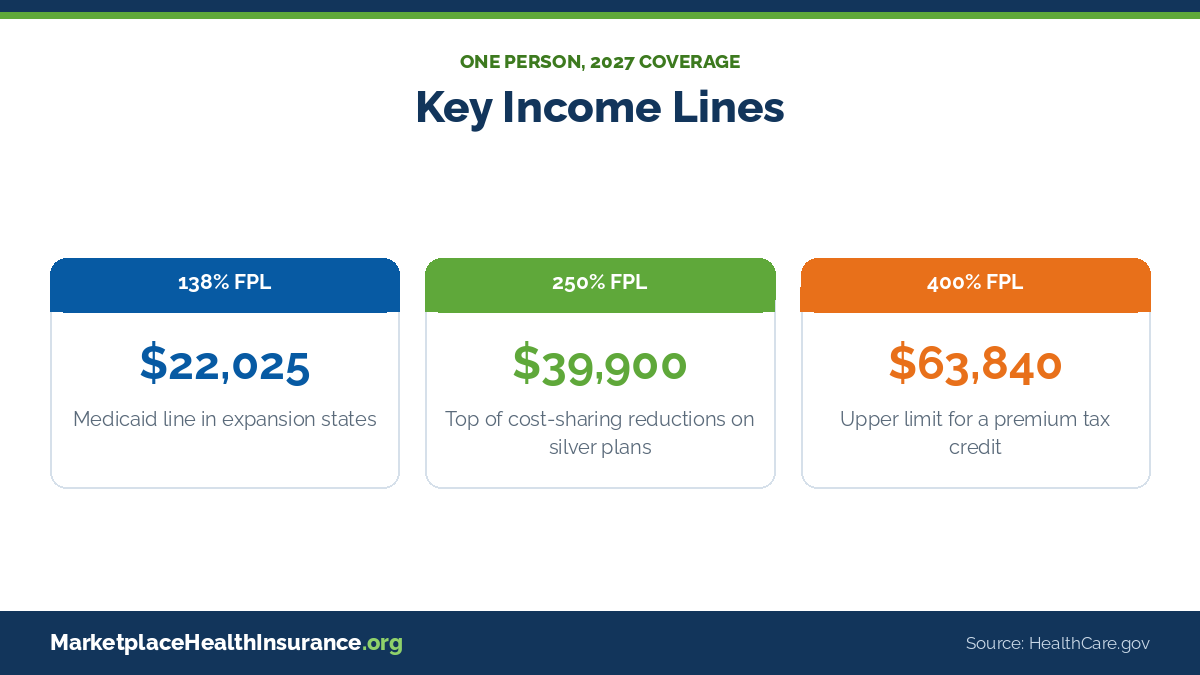
Obamacare income limits 2027 decide whether you get help paying for a Marketplace plan and how much. For coverage in 2027, premium tax credits are available to households with income from 100% to 400% of the federal poverty level. For one person that is $15,960 to $63,840 a year; for a family of four it is $33,000 to $132,000.
Know your number
See Your 2027 Tax Credit Estimate
Enter your ZIP code and compare Marketplace plans with your estimated savings applied.
Plans, prices and savings vary by ZIP code, age, household size and income.
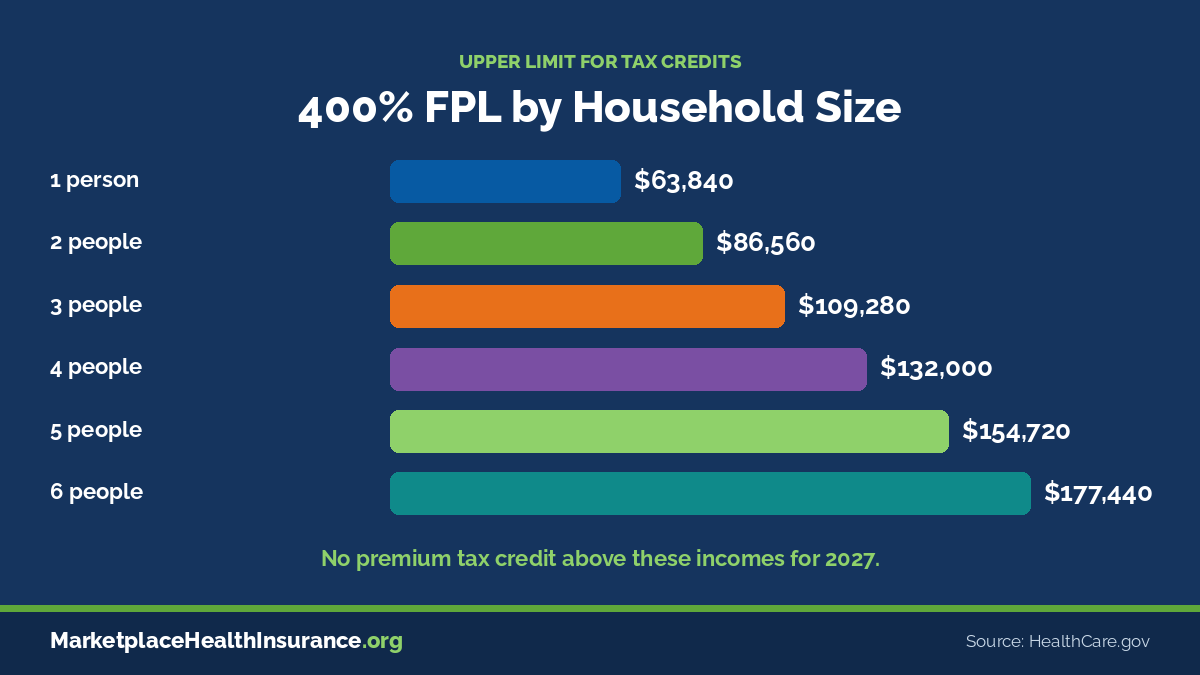
The upper limit is new again. From 2021 through 2025, enhanced tax credits had no income cap, but those expired at the end of 2025, and the original rules apply for 2027. The chart below shows every key income line by household size, followed by how the Marketplace counts income and what to do if you are near a cutoff. To see what the numbers mean for you, compare 2027 plans by ZIP code.
The short answer
For 2027 coverage, Obamacare premium tax credits go to households earning 100% to 400% of the federal poverty level. That is $15,960 to $63,840 for one person, $21,640 to $86,560 for two and $33,000 to $132,000 for four. Above 400% there is no tax credit.
Obamacare Income Limits 2027 Chart
Each line in this chart triggers a different kind of help. The amounts are based on the poverty guidelines used for 2027 coverage in the 48 contiguous states and Washington, D.C. Alaska and Hawaii use higher guidelines.
| Household | 100% FPL | 138% FPL | 250% FPL | 400% FPL |
|---|---|---|---|---|
| 1 person | $15,960 | $22,025 | $39,900 | $63,840 |
| 2 people | $21,640 | $29,863 | $54,100 | $86,560 |
| 3 people | $27,320 | $37,702 | $68,300 | $109,280 |
| 4 people | $33,000 | $45,540 | $82,500 | $132,000 |
| 5 people | $38,680 | See your state | See your state | $154,720 |
| 6 people | $44,360 | See your state | See your state | $177,440 |
100% is the usual minimum for a tax credit, 138% is the Medicaid line in expansion states, 250% is the top of cost-sharing reductions and 400% is the upper limit. Source: HealthCare.gov.
The bottom of the range matters most in states that have not expanded Medicaid, such as Georgia and Texas, where adults below 100% FPL may have no affordable option.
What Each Income Line Means
Below 100% FPL
No premium tax credit. In expansion states, adults usually qualify for Medicaid; in some other states adults fall into a coverage gap.
100% to 138% FPL
Medicaid in expansion states. In non-expansion states, a tax credit and the strongest cost-sharing help.
138% to 250% FPL
Premium tax credit plus cost-sharing reductions that lower deductibles and copays on silver plans.
250% to 400% FPL
Premium tax credit only. The amount shrinks as income rises.
Above 400% FPL
No premium tax credit for 2027. Plans are sold at full price.
The tax credit is designed to cap what you pay for the benchmark plan, the second-lowest-cost silver plan in your area, at a percentage of income. Because premiums rose again for 2027, the credit grows for people who qualify, while people above the limit pay the full increase.
The 400% Subsidy Cliff Is Back
The cliff means one extra dollar of income above 400% FPL can remove the entire tax credit. For a couple that line is $86,560, and for a family of four it is $132,000. For older enrollees, whose full-price premiums are highest, the difference can be thousands of dollars a year.
Ways income may come down
✔
Pre-tax contributions to a workplace retirement plan
✔
Deductible contributions to a traditional IRA, if eligible
✔
Health savings account contributions with an HSA-qualified plan
✔
Self-employment business expenses and half of self-employment tax
Income that is easy to forget
✕
Capital gains from selling investments
✕
Traditional IRA or 401(k) withdrawals
✕
Taxable part of Social Security benefits
✕
Tax-exempt interest and some foreign income
Get tax advice near the line
Repayment caps on excess premium tax credits were eliminated starting with the 2026 tax year. If your 2027 income could land near 400% FPL, talk with a tax professional before deciding how much of your credit to take in advance.

From the agent’s desk
Households just above 400% of the poverty level often have options. A larger workplace retirement contribution or an HSA-eligible plan can bring 2027 income under the line and restore a tax credit worth more than the contribution costs in take-home pay. Running those numbers before choosing a plan is worth the time.
Russell Noga, Licensed Insurance Agent
How the Marketplace Counts Your Income
Obamacare income limits use modified adjusted gross income (MAGI) for your whole tax household. That is your adjusted gross income from your federal return, plus untaxed foreign income, non-taxable Social Security benefits and tax-exempt interest.
Who is in your household
- ✔You, the person filing taxes.
- ✔Your spouse, if you file jointly. Married couples generally must file jointly to get a tax credit.
- ✔Anyone you claim as a tax dependent, even if they do not need coverage.
- ✔Not included: adult children or relatives you do not claim on your taxes.
Most importantly, the Marketplace uses the income you expect for 2027, not your last tax return. If you are starting a new job, retiring, changing hours or launching a business, base your estimate on the year ahead.
2027 Marketplace Plans
Call a Licensed Agent Now
A licensed agent can compare 2027 Marketplace plans in your ZIP code and check your premium tax credit at no cost.
TTY 711 · Mon–Fri 8am–8pm ET · No obligation to enroll
Other 2027 Eligibility Rules
- Job-based coverage. If an employer offers you coverage that is considered affordable and meets minimum value, you generally cannot get a tax credit, whatever your income.
- Medicaid work requirements. Starting in 2027, people denied or removed from Medicaid solely for not meeting work requirements are not eligible for premium tax credits.
- Immigration status. For 2027, tax credits are limited to lawful permanent residents, Cuban and Haitian entrants and COFA residents. Refugees and asylees can buy a plan without a credit.
- State help. New Mexico fully replaces the lost federal help, California extended partial help to 165% to 200% FPL, New Jersey kept its program, and Rhode Island and Virginia created new state subsidies.
If you live in one of those states, check your state exchange or our state guides, such as the New Mexico health insurance marketplace page. Everyone else applies through the health insurance marketplace on HealthCare.gov.
Using the Income Limits to Choose a Plan
1
Find your band. Use the chart to see whether you fall in the Medicaid, cost-sharing, tax credit only or full-price range.
2
Price a silver plan first if you are under 250% FPL. Cost-sharing reductions only apply to silver plans and can lower a deductible sharply.
3
Compare total yearly cost. Add 12 months of premium to the deductible you might realistically meet.
4
Report changes during the year. If your income or household changes in 2027, update your application so your credit stays accurate.
Open enrollment runs through January 15, 2027 in HealthCare.gov states, with later dates in some state exchanges. Full details are on the open enrollment 2027 page, and the Obamacare 2027 overview explains plan types and costs.
Deadline December 15
Compare 2027 Plans With Your Savings
Choose a plan by December 15, 2026 in HealthCare.gov states for coverage starting January 1, 2027.
Plans, prices and savings vary by ZIP code, age, household size and income.
Obamacare Income Limits 2027 FAQs
➤ What are the Obamacare income limits for 2027?
Premium tax credits go to households with income from 100% to 400% of the federal poverty level. For 2027 coverage that is $15,960 to $63,840 for one person and $33,000 to $132,000 for a family of four.
➤ Is there an upper income limit for Obamacare in 2027?
Yes. The enhanced tax credits that removed the upper limit expired at the end of 2025, so households above 400% FPL do not get a premium tax credit for 2027. They can still buy a plan at full price.
➤ What income counts for Obamacare?
Modified adjusted gross income for your tax household: adjusted gross income plus non-taxable Social Security, tax-exempt interest and untaxed foreign income. Use your expected 2027 income.
➤ What is the income limit for cost-sharing reductions in 2027?
Cost-sharing reductions are available on silver plans up to 250% FPL, which is $39,900 for one person, $54,100 for two and $82,500 for four.
➤ What if my income changes during 2027?
Report it to the Marketplace as soon as possible. Your tax credit is reconciled on your tax return, and with repayment caps gone you could owe back the full excess.
➤ Are income limits higher in Alaska and Hawaii?
Yes. Alaska and Hawaii have higher poverty guidelines, so their dollar limits are higher than the amounts in this chart.
Free Plan Comparison
Call a Licensed Agent Now
Compare 2027 Marketplace plans and savings with a licensed agent in one call.
TTY 711 · Mon–Fri 8am–8pm ET · No obligation to enroll
About the Author: Russell Noga
Russell Noga is a licensed insurance agent and the founder of ZRN Health & Financial Services, LLC. He has helped people compare health and supplemental insurance for more than 16 years and reviews every page on MarketplaceHealthInsurance.org before it is published.
MarketplaceHealthInsurance.org is privately owned and operated by ZRN Health & Financial Services, LLC, based in Austin, Texas. We are not HealthCare.gov or any state exchange and are not connected with or endorsed by any government agency. Premiums, subsidies and plan availability vary by state, ZIP code, age, household size and income. Calls may be answered by a licensed insurance agent from a partner agency.