


Reviewed by Russell Noga, Licensed Insurance Agent · Updated November 19, 2026
Marketplace health insurance 2027 plans are the individual and family policies sold under the Affordable Care Act through HealthCare.gov and state-run exchanges. They cover pre-existing conditions, include the ACA’s essential health benefits and are the only individual plans that come with a premium tax credit to lower the monthly cost.
2027 plans are available now
Compare Marketplace Plans in Your ZIP Code
See 2027 premiums, deductibles and networks from the insurers in your area, plus your estimated premium tax credit.
Plans, prices and savings vary by ZIP code, age, household size and income.
MarketplaceHealthInsurance.org helps you understand the 2027 rules, compare plans in your area and enroll before the deadline. Enter your ZIP code at the top of this page on MarketplaceHealthInsurance.org to see 2027 premiums, deductibles and your estimated savings, or keep reading for what changed this year.
The short answer
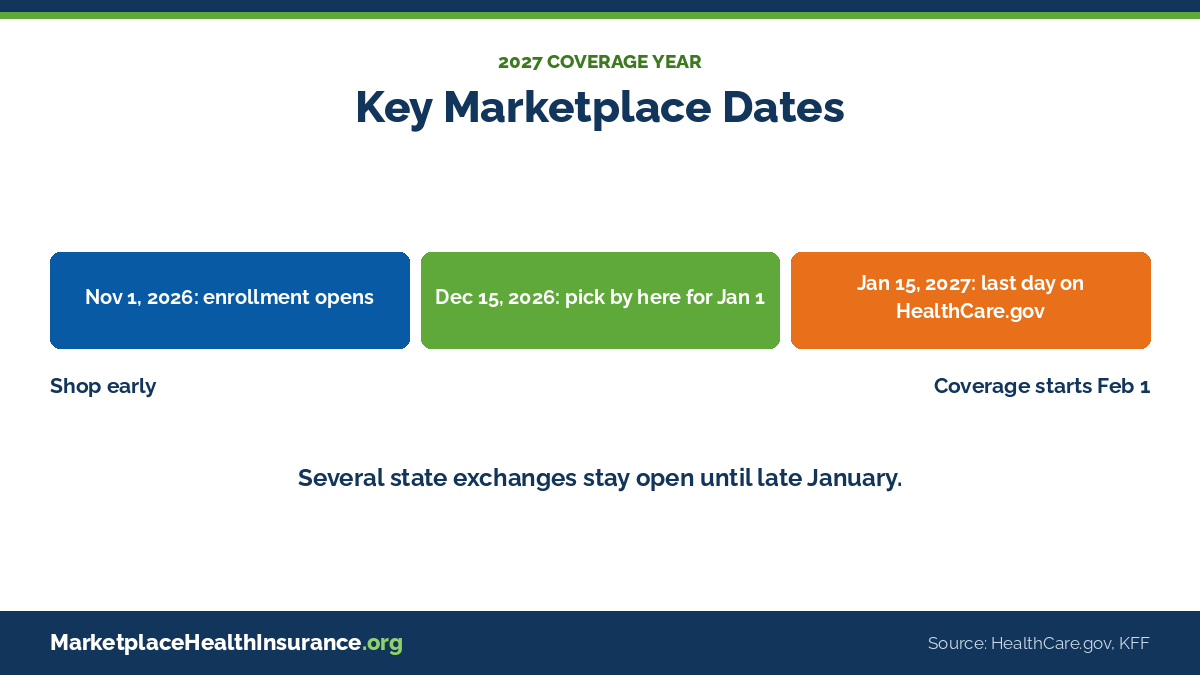
For 2027, Marketplace open enrollment runs November 1, 2026 to January 15, 2027 on HealthCare.gov. The average benchmark silver premium rose 13%, enhanced subsidies have ended, and premium tax credits are again limited to household incomes from 100% to 400% of the federal poverty level.
What Marketplace Health Insurance Covers
Every Marketplace plan must cover the same core services, so the real differences are price, network and how costs are shared. You cannot be turned down or charged more for a health condition, and preventive care such as screenings and vaccines is covered without a copay when you use in-network providers.
Essential health benefits
Doctor visits, hospital stays, emergency care, maternity and newborn care, mental health, prescriptions, lab work and pediatric dental and vision.
Pre-existing conditions
Insurers cannot deny coverage or raise your premium because of your health history.
Out-of-pocket limit
Every plan caps what you pay for covered in-network care in a year.
Financial help
Premium tax credits and, on silver plans, cost-sharing reductions lower costs for eligible households.
If you are new to the program, our explainer on what ACA insurance is covers the basics in plain language.
2027 Open Enrollment Dates
| Date | What it means |
|---|---|
| November 1, 2026 | Open enrollment begins for 2027 coverage |
| December 15, 2026 | Last day to choose a plan that starts January 1, 2027 |
| January 15, 2027 | Open enrollment ends on HealthCare.gov; coverage starts February 1 |
| After January 15, 2027 | Enrollment only with a qualifying life event, usually within 60 days |
Some state exchanges close later, including California, New Jersey, New York, Rhode Island and DC on January 31, 2027. Idaho closes December 15, 2026.
A federal rule that would have shortened open enrollment was vacated in court, so the usual calendar applies. The Marketplace open enrollment guide lists every state exchange deadline.
What Marketplace Plans Cost in 2027
Premiums rose again for 2027. The enhanced premium tax credits that kept prices low from 2021 through 2025 expired, and insurers raised rates to reflect higher medical prices and a smaller, sicker pool of enrollees.
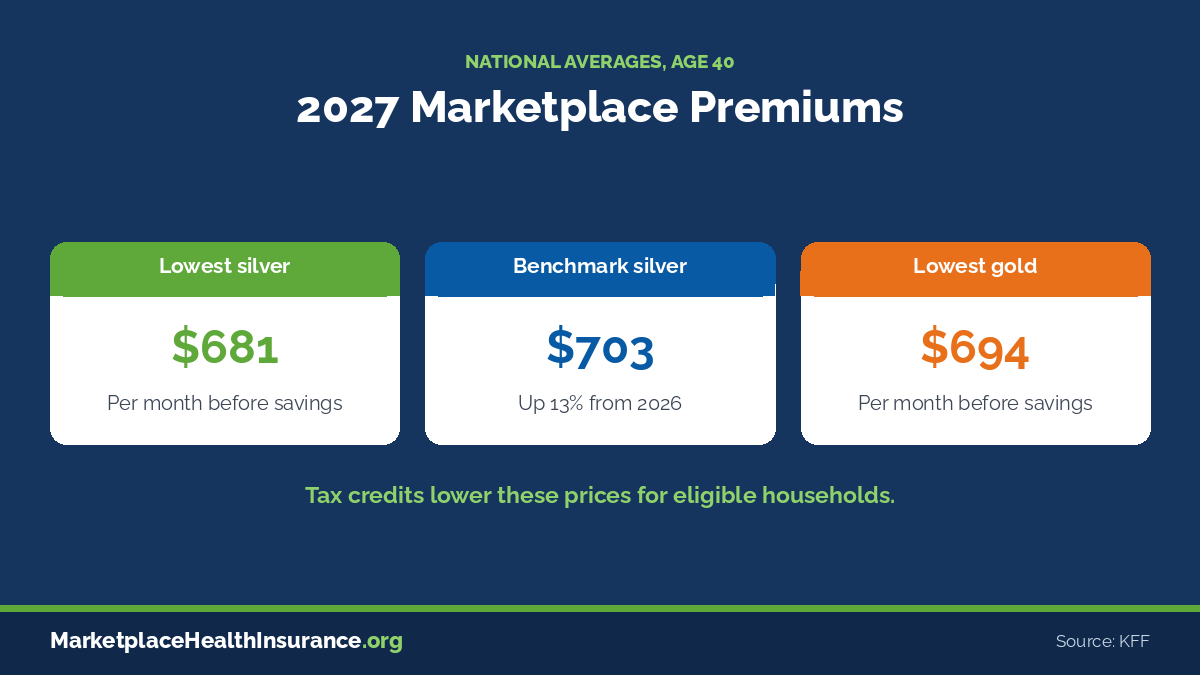
2027 premiums at a glance
+13%
Average benchmark silver change
$703
Average benchmark per month, age 40, before savings
$681
Average lowest-cost silver per month
$694
Average lowest-cost gold per month
These are national averages before any tax credit. Prices change by state, county, age and tobacco use. HealthCare.gov states averaged about an 11% benchmark increase and state-run exchanges about 16%, so where you live matters as much as which plan you pick.
2027 Marketplace Plans
Call a Licensed Agent Now
A licensed agent can compare 2027 Marketplace plans in your ZIP code and check your premium tax credit at no cost.
TTY 711 · Mon–Fri 8am–8pm ET · No obligation to enroll
Who Qualifies for 2027 Premium Tax Credits
For 2027 the original ACA rules apply: premium tax credits are available for household incomes from 100% to 400% of the federal poverty level. Above 400% there is no credit, which is often called the subsidy cliff.
| Household size | Minimum (100% FPL) | Maximum for tax credit (400% FPL) |
|---|---|---|
| 1 | $15,960 | $63,840 |
| 2 | $21,640 | $86,560 |
| 3 | $27,320 | $109,280 |
| 4 | $33,000 | $132,000 |
| 5 | $38,680 | $154,720 |
| 6 | $44,360 | $177,440 |
2026 federal poverty guidelines used for 2027 coverage, 48 states and DC. Alaska and Hawaii are higher. In Medicaid expansion states, adults under 138% FPL usually qualify for Medicaid instead.
Estimate income carefully
Repayment caps on excess premium tax credit were eliminated starting with the 2026 tax year. If your actual 2027 income is higher than estimated, you may have to pay back the full difference at tax time.
Several states add their own help for 2027. New Mexico fully replaces the lost federal assistance, California extended partial help to incomes from 165% to 200% FPL, New Jersey continues its program, and Rhode Island and Virginia created new state subsidies.

From the agent’s desk
Most renewing customers would save by comparing before December 15. With benchmark plans changing and some insurers leaving, the plan that was cheapest last year is often not the cheapest this year, and the tax credit is the same no matter which plan is chosen.
Russell Noga, Licensed Insurance Agent
Choosing a Metal Level
| Metal level | Monthly premium | Costs when you get care | Often a fit for |
|---|---|---|---|
| Bronze | Lowest | Highest deductibles | People who rarely need care |
| Silver | Moderate | Moderate; much lower with cost-sharing reductions | Incomes up to 250% FPL |
| Gold | Higher | Lower deductibles and copays | Regular doctor visits or prescriptions |
| Catastrophic | Low | Very high deductible | Under 30 or with a hardship exemption |
Compare total yearly cost, not just premiums. Twelve months of premium plus a realistic deductible is the better yardstick, and each plan’s doctor network and drug list should be checked before you enroll.
Insurance Companies on the Marketplace in 2027
Most areas have several insurers, but the lineup changed for 2027. Cigna is leaving the individual market in all 11 states where it sold plans. As of late October 2026, eleven carriers had exited at least one state and seven had entered a new one, so a plan you had in 2026 may not be offered again.
Our Marketplace health insurance companies guide profiles the carriers, and the health insurance marketplace hub links to a guide for every state.
How to Enroll in a 2027 Marketplace Plan
1
Enter your ZIP code. Plans and prices are set by county, so your location comes first.
2
Add your household and 2027 income. This sets your premium tax credit and whether you qualify for extra savings on silver plans.
3
Compare plans. Look at premium, deductible, out-of-pocket maximum, network and drug coverage side by side.
4
Apply and choose a plan. Finish by December 15, 2026 for coverage on January 1, 2027.
5
Pay the first premium. Coverage starts once the insurance company receives the first payment.
Have these ready
- ✔Social Security numbers or immigration document numbers for each applicant
- ✔Pay stubs or another basis for your 2027 income estimate
- ✔Details of any job-based coverage offered to your household
- ✔A list of your doctors and prescriptions
Deadline: December 15 for January 1
Start Your 2027 Coverage on Time
Enter your ZIP code to compare plans and lock in coverage before open enrollment closes.
Plans, prices and savings vary by ZIP code, age, household size and income.
Marketplace Health Insurance FAQs
➤ What is marketplace health insurance?
It is individual and family health coverage sold through HealthCare.gov or a state exchange under the Affordable Care Act. Plans cover essential health benefits and pre-existing conditions, and eligible households can get premium tax credits.
➤ When can I enroll in a 2027 Marketplace plan?
Open enrollment runs from November 1, 2026 to January 15, 2027 on HealthCare.gov. Choose a plan by December 15, 2026 for January 1 coverage. Some state exchanges stay open until late January.
➤ How much does marketplace health insurance cost in 2027?
The national average benchmark silver premium for a 40-year-old is $703 a month before savings, up 13% from 2026. What you pay depends on your state, age, income and the plan you choose.
➤ What income qualifies for Marketplace subsidies in 2027?
Household income between 100% and 400% of the federal poverty level, which is $15,960 to $63,840 for one person and $33,000 to $132,000 for a family of four.
➤ Did the enhanced subsidies end?
Yes. The enhanced premium tax credits expired at the end of 2025, so 2027 uses the original ACA rules with a 400% FPL income limit.
➤ Can I get Marketplace coverage after open enrollment?
Only with a Special Enrollment Period triggered by a qualifying life event, such as losing other coverage, marriage, a birth or adoption, or a move. You usually have 60 days to enroll.
➤ Is MarketplaceHealthInsurance.org the government marketplace?
No. MarketplaceHealthInsurance.org is a private website that explains Marketplace coverage and helps you compare plans. It is not HealthCare.gov or a state exchange.
Free Plan Comparison
Call a Licensed Agent Now
Compare 2027 Marketplace plans and savings with a licensed agent in one call.
TTY 711 · Mon–Fri 8am–8pm ET · No obligation to enroll
About the Author: Russell Noga
Russell Noga is a licensed insurance agent and the founder of ZRN Health & Financial Services, LLC. He has helped people compare health and supplemental insurance for more than 16 years and reviews every page on MarketplaceHealthInsurance.org before it is published.
MarketplaceHealthInsurance.org is privately owned and operated by ZRN Health & Financial Services, LLC, based in Austin, Texas. We are not HealthCare.gov or any state exchange and are not connected with or endorsed by any government agency. Premiums, subsidies and plan availability vary by state, ZIP code, age, household size and income. Calls may be answered by a licensed insurance agent from a partner agency.