


Reviewed by Russell Noga, Licensed Insurance Agent · Updated November 19, 2026
The health insurance premium increase 2027 by state ranges from single digits in a few places to well over 20% in others. Nationally, the average benchmark silver premium on the ACA Marketplace rose 13% for 2027, the second double-digit jump in a row, after a rise of about 26% from 2025 to 2026.
Check your 2027 price
See What 2027 Plans Cost in Your ZIP Code
State averages do not tell you your price. Compare real 2027 premiums and your estimated tax credit.
Plans, prices and savings vary by ZIP code, age, household size and income.
This page collects the numbers in one place: the approved average rate changes reported by state regulators, the 2027 benchmark premium in every state, and what is driving the increase. It ends with practical steps to lower your own bill. To see what your household would actually pay after savings, compare 2027 Marketplace plans by ZIP code.
The short answer
For 2027, the average benchmark silver Marketplace premium rose 13% nationally: about 11% in HealthCare.gov states and about 16% in states that run their own exchange. Approved average rate changes vary widely, from 6% in New York to 25% in Alabama among states with final figures.
2027 Premium Increases at the National Level
Two measures are worth knowing. The first is the change in the benchmark premium, which is the second-lowest-cost silver plan in an area. It sets the size of every premium tax credit. The second is the average rate change insurers file and regulators approve, which tells you how much a typical existing plan went up.
2027 Marketplace premiums in numbers
+13%
Average benchmark silver change, all states
+11%
HealthCare.gov states
+16%
State-run exchanges
15%
Median proposed rate change across 276 insurers
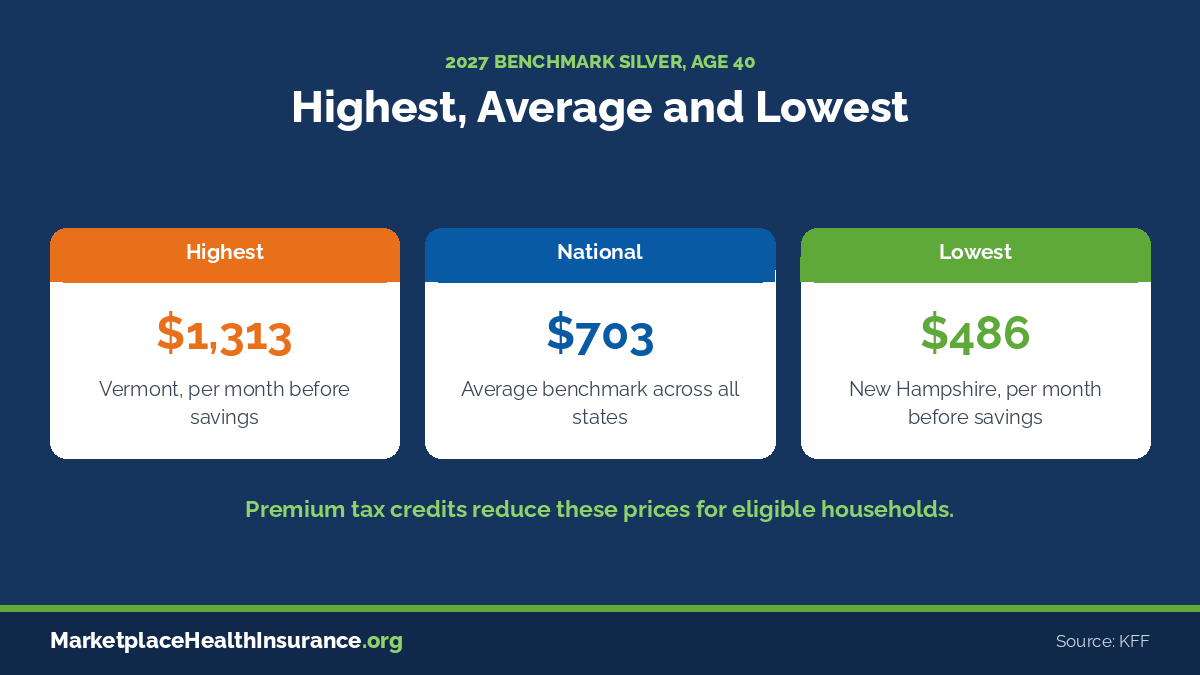
$703
National average monthly benchmark, age 40, before savings
The 2026 median finalized change was 20%, so 2027 increases are somewhat smaller, but they land on top of last year’s jump. KFF estimates the benchmark premium is up about 42% from 2025 to 2027 combined.
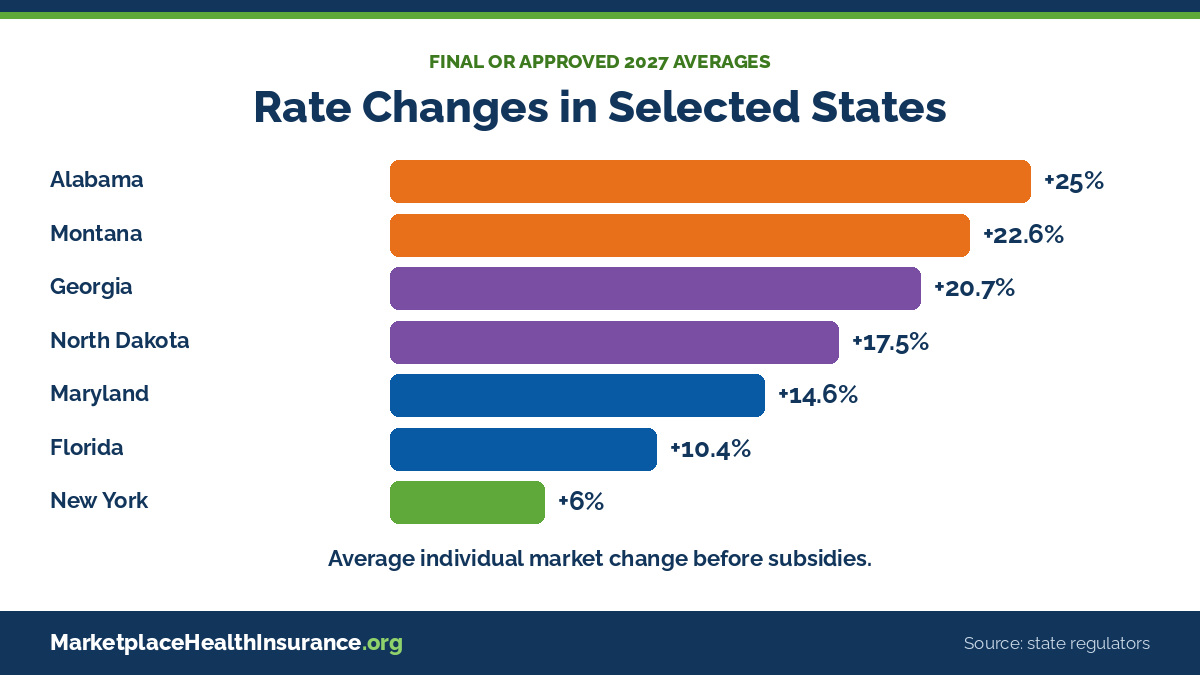
Approved Average Rate Changes by State for 2027
These are average individual-market rate changes that state regulators finalized or approved, as reported in October 2026. They are averages across insurers, before subsidies. Your plan’s change can be higher or lower.
| State | Average 2027 rate change | Status |
|---|---|---|
| Alabama | +25% | Final |
| New Mexico | +24.4% | Final |
| Montana | +22.6% | Final |
| Washington | +22.2% | Approved (insurers requested 22.4%) |
| Oregon | +21.6% | Final (initial request 17.5%) |
| Georgia | +20.7% | Final |
| North Dakota | +17.5% | Final, weighted average |
| Maryland | +14.6% | Final |
| Connecticut | +11.3% | Approved (requests averaged 16.2%) |
| Florida | +10.4% | Final, weighted average |
| New York | +6% | Approved (insurers asked for 20.6%) |
Sources: state insurance regulators as reported by Insurance Business (Oct 6, 2026) and ACA Signups. Proposed requests in other states were still under review at that time, including Arizona, where insurers asked for 29%.
Some states with large average increases still saw lower benchmark premiums, because the benchmark depends on which silver plan ranks second-lowest in each county. Oregon is an example: its average rate change was 21.6%, yet its average benchmark fell from $543 to $519 a month. See the Oregon health insurance marketplace guide for local details.
Average Benchmark Premium in Every State for 2027
The table below shows KFF’s 2027 average monthly benchmark premium for a 40-year-old in each state, weighted by county plan selections. These are prices before any premium tax credit.
| State | 2027 benchmark | State | 2027 benchmark |
|---|---|---|---|
| Vermont | $1,313 | Oklahoma | $686 |
| Alaska | $1,284 | District of Columbia | $678 |
| Wyoming | $1,190 | Missouri | $675 |
| West Virginia | $1,185 | Kentucky | $667 |
| New York | $1,041 | New Jersey | $665 |
| Connecticut | $1,005 | North Carolina | $660 |
| Montana | $889 | California | $655 |
| Delaware | $876 | Pennsylvania | $648 |
| Mississippi | $814 | Rhode Island | $629 |
| Maine | $804 | Colorado | $615 |
| Tennessee | $796 | North Dakota | $610 |
| Nebraska | $780 | Arizona | $609 |
| Washington | $768 | Ohio | $603 |
| Arkansas | $757 | Michigan | $595 |
| Kansas | $748 | Hawaii | $592 |
| Florida | $738 | Nevada | $565 |
| Texas | $737 | Idaho | $553 |
| Georgia | $733 | Massachusetts | $551 |
| Louisiana | $730 | Virginia | $549 |
| New Mexico | $725 | Indiana | $537 |
| Wisconsin | $720 | Iowa | $528 |
| Utah | $716 | Minnesota | $525 |
| Alabama | $712 | Oregon | $519 |
| Illinois | $707 | Maryland | $491 |
| South Dakota | $704 | New Hampshire | $486 |
| South Carolina | $702 |
Source: KFF state indicator, average benchmark premiums (second-lowest-cost silver, age 40), as reported November 2026.
Benchmark premiums are highest in Vermont and Alaska and lowest in New Hampshire and Maryland. A high benchmark also means a larger premium tax credit for people who qualify, so subsidized enrollees in high-cost states are partly shielded.

From the agent’s desk
A statewide average rarely matches an individual renewal notice. Two neighbors in the same state can see very different changes depending on the insurer, the county and whether their plan is still the benchmark. Comparing the renewal against the current lowest-cost silver and bronze plans shows the real choice.
Russell Noga, Licensed Insurance Agent
Why Premiums Are Rising Again in 2027
Enhanced tax credits ended
The extra help that applied from 2021 through 2025 expired. Healthier people dropped coverage, leaving a sicker risk pool.
Provider prices
Hospitals and doctors negotiated higher payments, and insurers pass those costs into premiums.
Inflation and labor
General inflation and health care labor shortages raise the cost of every claim.
Smaller markets
CBO projects Marketplace enrollment falling from 22.4 million in 2025 to 13.1 million in 2027, spreading fixed costs over fewer people.
Insurer exits add pressure in some areas. Cigna is leaving the individual market in all 11 states where it sold plans, and as of late October 2026 eleven carriers had left at least one state while seven entered a new one. The Marketplace health insurance companies guide tracks who sells where.
2027 Marketplace Plans
Call a Licensed Agent Now
A licensed agent can compare 2027 Marketplace plans in your ZIP code and check your premium tax credit at no cost.
TTY 711 · Mon–Fri 8am–8pm ET · No obligation to enroll
Who Feels the 2027 Increase the Most
Premium tax credits are pegged to the benchmark, so people who qualify are protected from much of the sticker increase. The people who absorb the full increase are those without a credit.
Partly shielded
✔
Households from 100% to 400% of the federal poverty level.
✔
Silver plan enrollees with income up to 250% FPL, who also get lower deductibles.
✔
Residents of New Mexico, California, New Jersey, Rhode Island and Virginia, which offer state help for 2027.
Exposed to the full increase
✕
Households above 400% FPL, such as a couple earning more than $86,560.
✕
Older enrollees just over the income limit, whose full-price premiums are highest.
✕
People who keep a plan that is no longer the cheapest in their area.
Watch the subsidy cliff
For 2027 coverage, a single person earning $63,840 or more and a family of four earning $132,000 or more get no premium tax credit. Small income changes near these lines can change your premium by thousands of dollars a year.
How to Lower Your 2027 Premium
1
Shop instead of renewing. Your current plan may no longer be the best value in your county, especially if the benchmark plan changed.
2
Update your income estimate. An accurate 2027 estimate sets the right tax credit. Repayment caps are gone, so overestimating savings is risky.
3
Compare bronze and silver. A bronze plan lowers the monthly bill, while silver unlocks cost-sharing reductions if your income is at or below 250% FPL.
4
Check state programs. Several states added or kept their own subsidies for 2027. Your state’s guide, such as the Florida health insurance marketplace page, lists local options.
5
Enroll by the deadline. Pick a plan by December 15, 2026 for January 1 coverage. Open enrollment ends January 15, 2027 on HealthCare.gov; see the open enrollment dates.
Do not auto-renew blind
Find a Lower 2027 Premium Before December 15
Switching plans during open enrollment is the main way to offset a rate increase.
Plans, prices and savings vary by ZIP code, age, household size and income.
2027 Premium Increase FAQs
➤ How much are health insurance premiums increasing in 2027?
The average benchmark silver Marketplace premium rose 13% for 2027. Insurers’ median proposed increase was 15%, and approved state averages range from about 6% to 25% among states with final figures.
➤ Which state has the highest health insurance premiums in 2027?
Vermont has the highest average benchmark premium for 2027 at $1,313 a month for a 40-year-old before subsidies, followed by Alaska at $1,284, according to KFF.
➤ Which state has the lowest Marketplace premiums in 2027?
New Hampshire has the lowest average benchmark premium at $486 a month, followed by Maryland at $491, according to KFF.
➤ Why are ACA premiums going up in 2027?
Insurers cite rising provider prices, inflation, labor shortages and the expiration of enhanced premium tax credits at the end of 2025, which left a sicker risk pool.
➤ Will my subsidy cover the 2027 increase?
If your income is between 100% and 400% of the federal poverty level, your premium tax credit rises with the benchmark, which offsets much of the increase. Above 400% there is no credit.
➤ Can I avoid the 2027 premium increase?
You can often reduce it by comparing plans during open enrollment, updating your income estimate and checking whether a different metal level or insurer costs less in your area.
Free Plan Comparison
Call a Licensed Agent Now
Compare 2027 Marketplace plans and savings with a licensed agent in one call.
TTY 711 · Mon–Fri 8am–8pm ET · No obligation to enroll
About the Author: Russell Noga
Russell Noga is a licensed insurance agent and the founder of ZRN Health & Financial Services, LLC. He has helped people compare health and supplemental insurance for more than 16 years and reviews every page on MarketplaceHealthInsurance.org before it is published.
MarketplaceHealthInsurance.org is privately owned and operated by ZRN Health & Financial Services, LLC, based in Austin, Texas. We are not HealthCare.gov or any state exchange and are not connected with or endorsed by any government agency. Premiums, subsidies and plan availability vary by state, ZIP code, age, household size and income. Calls may be answered by a licensed insurance agent from a partner agency.