


Reviewed by Russell Noga, Licensed Insurance Agent · Updated November 20, 2026
A health insurance plan finder is a tool that shows every individual and family plan sold where you live, with prices adjusted for your household and income. For the 2027 plan year it does more work than usual: premiums rose again, the enhanced tax credits are gone and several insurers changed where they sell, so the plan you had last year may not be the best fit or may not exist.
Free plan finder
Find 2027 Plans in Your ZIP Code
See every Marketplace plan where you live, with premiums, deductibles and your estimated savings.
Plans, prices and savings vary by ZIP code, age, household size and income.
This guide explains what information a plan finder needs, how to read the results, which filters matter most and how to turn a long list into one confident choice. You can start right now with our Marketplace plan finder by entering your ZIP code.
The short answer
A health insurance plan finder lists the Marketplace plans in your ZIP code with your estimated premium after any tax credit. Enter your ZIP, household size, ages and expected 2027 income, then compare plans by premium plus deductible, network and drug coverage. Choose by December 15, 2026 in HealthCare.gov states for January 1 coverage.
What a Health Insurance Plan Finder Shows You
Marketplace plans are sold by county, so the first thing any plan finder needs is your ZIP code. From there it pulls the plans each insurer offers in your area and prices them for the people on your application. A good finder shows the following for each plan:
- Monthly premium, both the full price and your estimated price after a premium tax credit.
- Deductible and out-of-pocket maximum, which show how much you could pay before the plan covers most costs.
- Copays and coinsurance for doctor visits, specialists, generic drugs and emergency care.
- Metal level and plan type, such as a silver HMO or a gold PPO.
- Network and drug list links so you can check doctors and prescriptions.
Every plan in the results covers the ACA’s essential health benefits and cannot turn you down or charge you more for a pre-existing condition. The differences are in price, cost sharing and network.
What to Enter for Accurate 2027 Prices
| Information | Why it matters |
|---|---|
| ZIP code and county | Plans and prices are set by area; some ZIP codes cross county lines |
| Ages of everyone applying | Premiums rise with age, up to three times as much for older adults |
| Household size | Sets your federal poverty level percentage |
| Expected 2027 household income | Decides your premium tax credit and silver plan extra help |
| Tobacco use | Some insurers charge more for tobacco users where allowed |
| Current coverage offers | An affordable job-based offer can affect tax credit eligibility |
Use income you expect for 2027, not last year’s tax return.
Income estimates matter more now
Starting with the 2026 tax year there is no cap on repaying excess premium tax credit. If a plan finder shows a large credit based on an income guess that turns out low, the difference may come back as a tax bill. A careful estimate keeps the numbers on screen honest.
For 2027 coverage, premium tax credits are available from 100% to 400% of the federal poverty level, about $15,960 to $63,840 for one person. See our Obamacare income limits 2027 guide for every household size.
How to Read Plan Finder Results
Most finders sort by premium first. That is useful, but it can hide plans that cost less over a full year. Read each result through three questions.
What will I pay every month?
The premium after your tax credit. This is certain, whether or not you use care.
What could I pay if I get sick?
The deductible and out-of-pocket maximum. This is the worst case for the year.
Can I see my doctors?
The network. A low-cost plan is not a bargain if your doctor is out of network.
Are my drugs covered?
The formulary. Check the tier for each prescription, not just whether it is listed.
A simple total-cost check helps: multiply the monthly premium by 12, then add the deductible if you expect regular care, or the out-of-pocket maximum if you want the worst case. Compare that total across two or three plans.

From the agent’s desk
Plan finder results sorted by premium alone lead many shoppers to the cheapest bronze plan. For anyone who expects regular doctor visits or ongoing prescriptions, the cheapest premium is often not the cheapest year. Adding the deductible to 12 months of premiums before choosing changes the ranking more often than not.
Russell Noga, Licensed Insurance Agent
Filters That Matter Most for 2027
1
Filter by metal level. Bronze has the lowest premiums and highest deductibles. Silver is the only level with cost-sharing reductions. Gold costs more monthly but less when you use care.
2
Check silver if income is at or below 250% FPL. For 2027 that is about $39,900 for one person or $82,500 for a family of four. Cost-sharing reductions can cut the deductible sharply.
3
Search your doctors. Use the provider filter or open each plan’s directory and search by name and location.
4
Add your prescriptions. Enter each drug and dose so the finder can show coverage and estimated cost.
5
Compare plan types. HMO and EPO plans usually need in-network care; PPO plans allow some out-of-network care at a higher cost.
6
Look at insurer changes. Cigna is leaving the individual market in all of its 11 states for 2027, and other carriers entered or left specific states. Confirm your insurer still sells in your county.
2027 Marketplace Plans
Call a Licensed Agent Now
A licensed agent can compare 2027 Marketplace plans in your ZIP code and check your premium tax credit at no cost.
TTY 711 · Mon–Fri 8am–8pm ET · No obligation to enroll
Why Premiums in the Plan Finder Look Higher for 2027
2027 price context
+13%
Average benchmark silver premium change
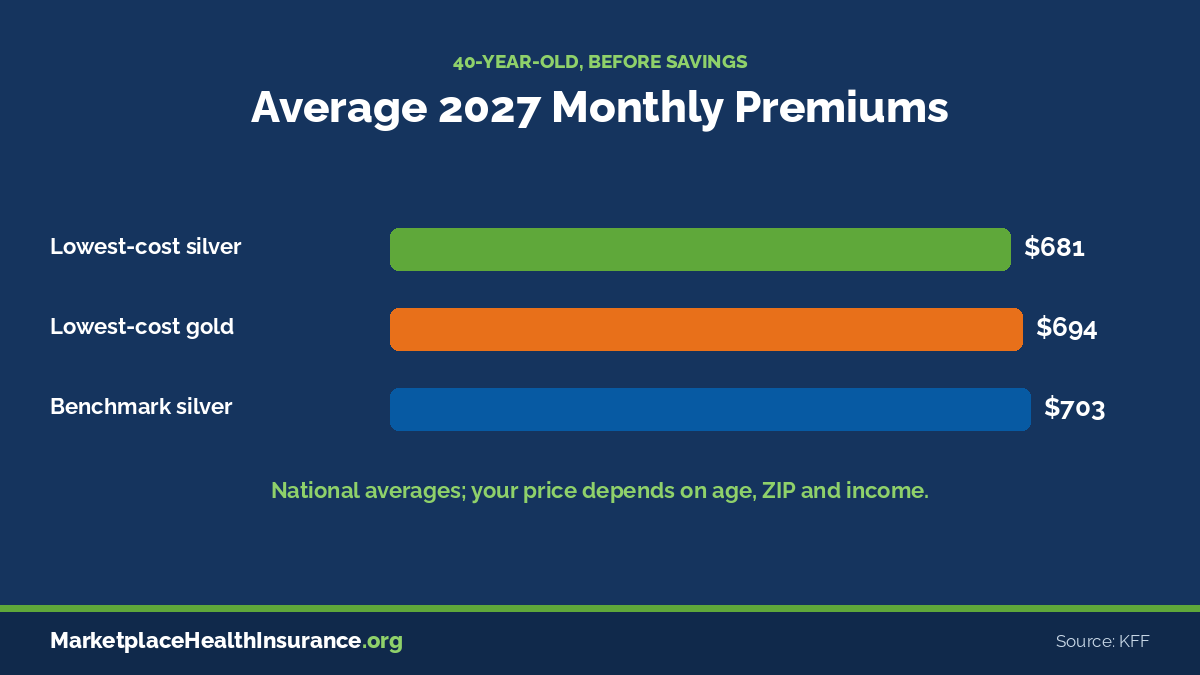
$703
National average benchmark silver, per month before savings
$681
Average lowest-cost silver premium, before savings
$694
Average lowest-cost gold premium, before savings
Those national averages are for a 40-year-old before any tax credit, from KFF. Your own result depends on your age, county and income. The enhanced premium tax credits that lowered prices from 2021 through 2025 expired, which is why many people see a bigger net increase than the rate change alone. Our health insurance premium increase 2027 guide explains the causes.
One pattern worth noticing: in many areas the lowest-cost gold plan is priced close to the benchmark silver plan. When that happens, a gold plan can give lower deductibles for a similar premium, so check gold results even if you planned to buy silver.
From Plan Finder to Enrollment
Before you enroll
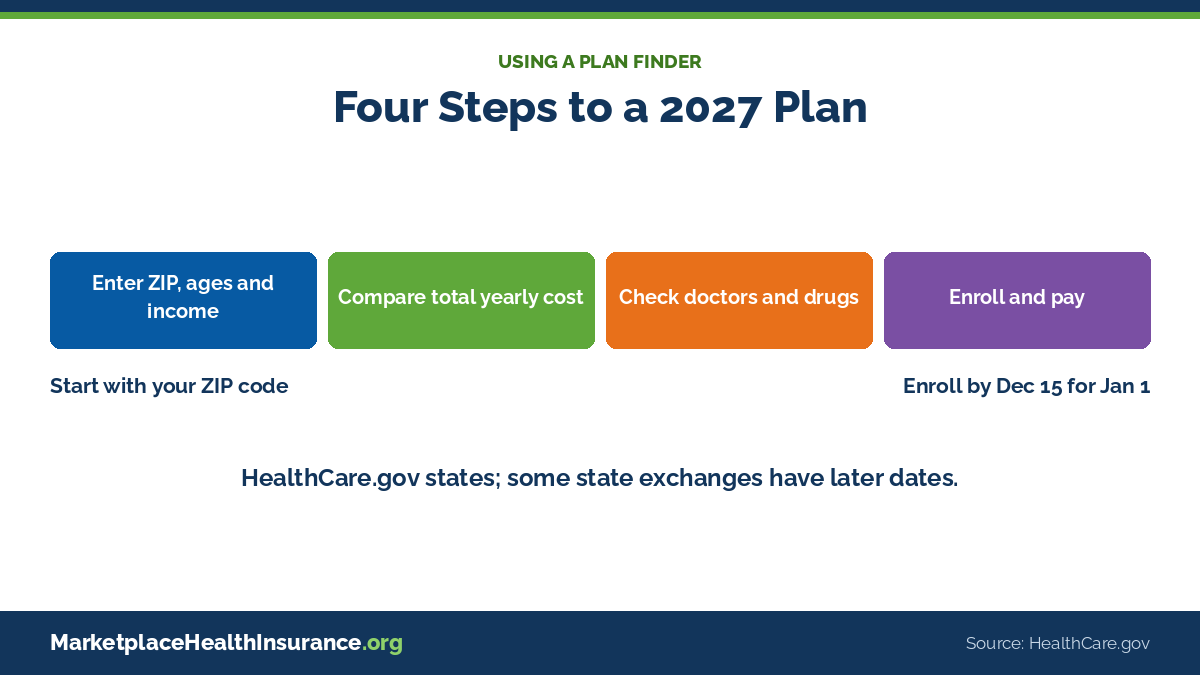
- ✔Shortlist two or three plans by total yearly cost.
- ✔Confirm doctors, hospitals and prescriptions for each one.
- ✔Check that your income estimate and household size are right.
- ✔Note the coverage start date for the day you enroll.
- ✔Enroll by December 15, 2026 for January 1 coverage in HealthCare.gov states.
- ✔Pay the first premium so coverage can begin.
Open enrollment runs November 1, 2026 to January 15, 2027 on HealthCare.gov, and some state exchanges stay open later. See our Marketplace open enrollment 2027 guide for state dates and our how to apply for Obamacare 2027 guide for the application itself. To learn more about insurers before you choose, browse the Marketplace health insurance companies list or our health insurance hub.
Narrow it down
Compare Your Top Plans Side by Side
Enter your ZIP code to line up premiums, deductibles and networks before the December 15 deadline.
Plans, prices and savings vary by ZIP code, age, household size and income.
Health Insurance Plan Finder FAQs
➤ What is a health insurance plan finder?
It is an online tool that shows the individual and family health plans sold in your ZIP code, with premiums, deductibles and estimated savings based on your household and income.
➤ Is it free to use a plan finder?
Yes. Plan finders, including HealthCare.gov and state exchange tools, are free to use, and you pay nothing extra to compare plans.
➤ Do I need to give my name to see prices?
Usually not. Most plan finders show estimated prices with just a ZIP code, ages and an income estimate. A full application is needed to enroll.
➤ Why is the price in the plan finder different from my final premium?
The estimate depends on the income and household details you enter. Your final tax credit is set by your application and reconciled on your tax return.
➤ Which metal level should I filter for?
It depends on how much care you expect. Bronze fits low users, silver fits incomes up to 250% FPL because of extra help, and gold fits people who use care regularly.
➤ Can I use a plan finder outside open enrollment?
You can browse plans any time, but you can enroll outside open enrollment only with a qualifying life event, such as losing coverage or moving.
➤ Does the plan finder show every insurer?
A Marketplace plan finder shows all insurers selling exchange plans in your area. Insurers change by year, so results for 2027 may differ from 2026.
Free Plan Comparison
Call a Licensed Agent Now
Compare 2027 Marketplace plans and savings with a licensed agent in one call.
TTY 711 · Mon–Fri 8am–8pm ET · No obligation to enroll
About the Author: Russell Noga
Russell Noga is a licensed insurance agent and the founder of ZRN Health & Financial Services, LLC. He has helped people compare health and supplemental insurance for more than 16 years and reviews every page on MarketplaceHealthInsurance.org before it is published.
MarketplaceHealthInsurance.org is privately owned and operated by ZRN Health & Financial Services, LLC, based in Austin, Texas. We are not HealthCare.gov or any state exchange and are not connected with or endorsed by any government agency. Premiums, subsidies and plan availability vary by state, ZIP code, age, household size and income. Calls may be answered by a licensed insurance agent from a partner agency.