


Reviewed by Russell Noga, Licensed Insurance Agent · Updated November 19, 2026
Health insurance 2027 is more expensive for many people who buy their own coverage. Marketplace premiums are rising for the second straight year, the extra federal help that lowered costs from 2021 through 2025 has ended, and several insurers have changed where they sell. The good news is that the core protections of the Affordable Care Act still apply, and most people who shop carefully can still find a plan that fits their budget.
Shopping for 2027 coverage?
See 2027 Health Plans in Your Area
Enter your ZIP code to compare Marketplace plans from every insurer in your county and estimate your premium tax credit.
Plans, prices and savings vary by ZIP code, age, household size and income.
This guide covers where to get health insurance for 2027, how Marketplace plans are priced, who qualifies for help paying, and how to compare insurers and plan types before you enroll. When you are ready, you can compare 2027 plans by ZIP code to see the insurers and prices in your county.
The short answer
For 2027, people without job-based coverage, Medicare or Medicaid can buy a Marketplace plan during open enrollment, which runs November 1, 2026 to January 15, 2027 in HealthCare.gov states. Premium tax credits are available for household incomes from 100% to 400% of the federal poverty level. Comparing every insurer and metal level in your ZIP code is the best way to find an affordable plan.
Where to Get Health Insurance in 2027
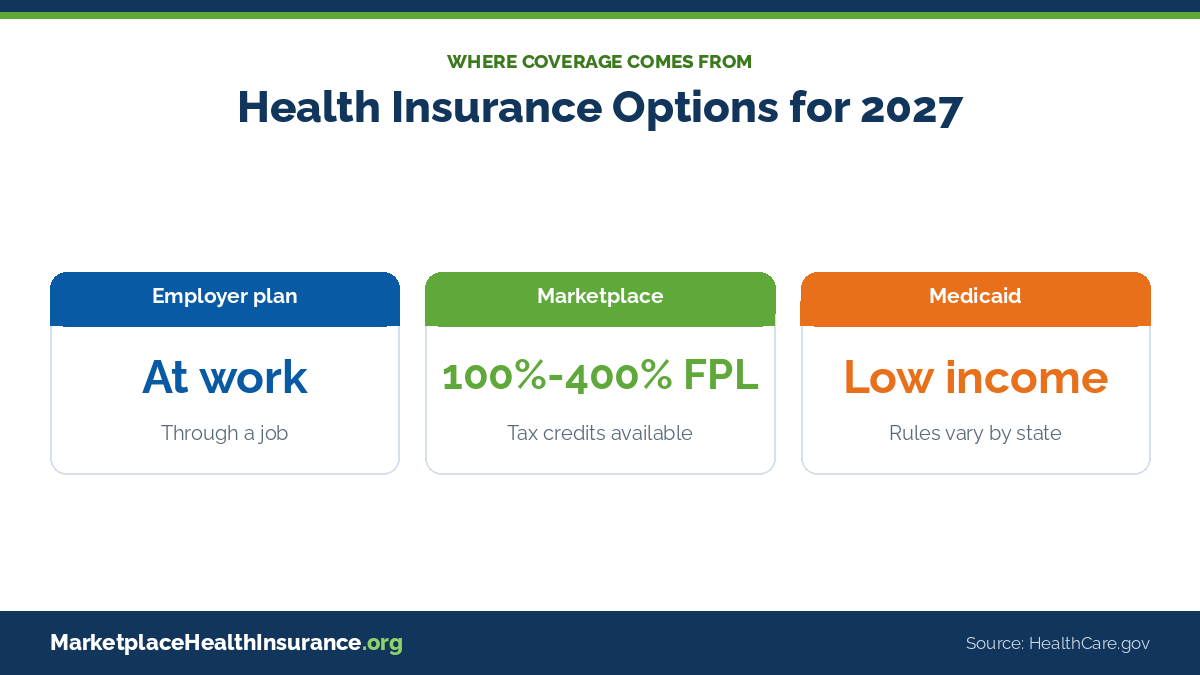
Most Americans get health insurance in one of a few ways. The right path depends on your job, age, income and household.
Employer coverage
Offered through your job or a family member’s job. If the employer plan is affordable and meets minimum value, you usually cannot get a Marketplace tax credit.
Marketplace plans
Individual and family plans sold on HealthCare.gov or a state exchange. Tax credits can lower the monthly premium.
Medicaid and CHIP
Free or low-cost coverage for people with limited income, children and some adults. Rules vary by state.
Medicare
Federal coverage for people 65 and older and some younger people with disabilities. It is separate from the Marketplace.
If you buy coverage on your own, the Marketplace is usually the best place to start because it is the only place to use a premium tax credit. Our health insurance marketplace hub explains how each state runs its exchange, and our guide to what ACA insurance is covers the basic protections.
Why Health Insurance Costs More for 2027
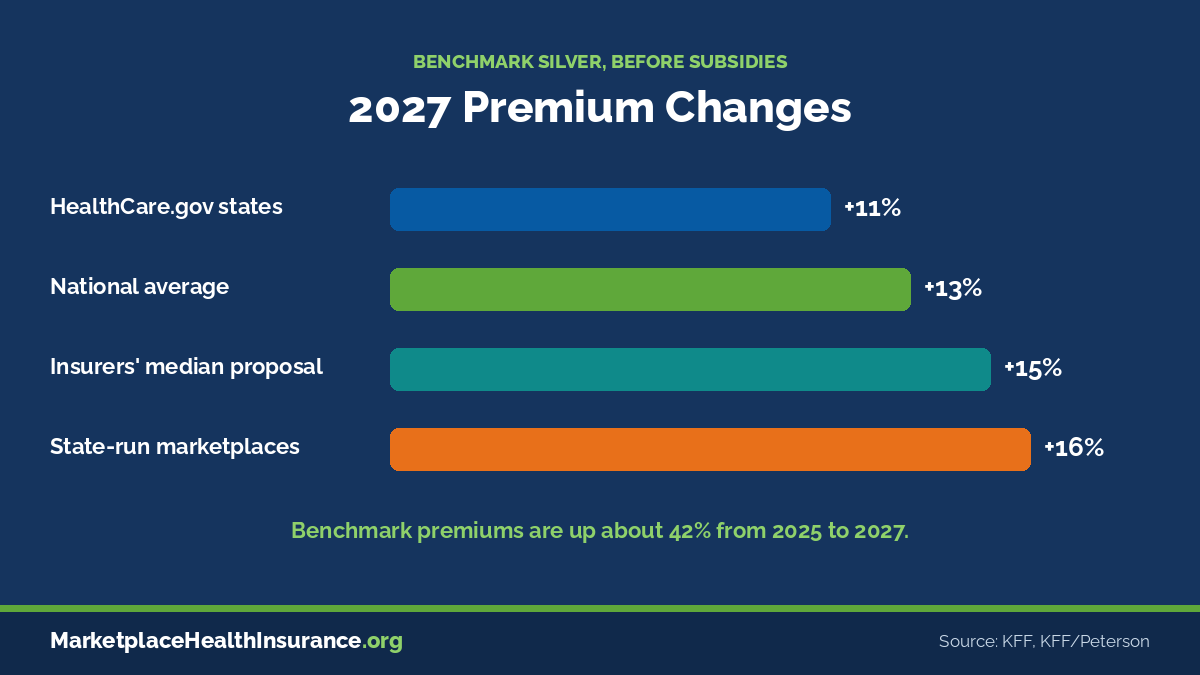
KFF reports that the average benchmark silver premium is rising 13% for 2027, after a jump of about 26% from 2025 to 2026. Taken together, benchmark premiums are up roughly 42% over two years. Increases are higher on average in state-run marketplaces than in HealthCare.gov states.
2027 Marketplace prices at a glance
+13%
Average benchmark silver premium change
$703
Average benchmark silver, age 40, per month before subsidy
$681
Average lowest-cost silver, age 40
$694
Average lowest-cost gold, age 40
Insurers point to rising hospital and provider prices, general inflation, staffing shortages and a sicker mix of enrollees after the enhanced premium tax credits expired at the end of 2025. Prices vary widely by state and county, so the national figures are only a starting point.

From the agent’s desk
The plan with the lowest monthly premium is not always the most affordable over a full year. For 2027, comparing silver and gold plans side by side often changes the answer, especially for households above 250% of the poverty level.
Russell Noga, Licensed Insurance Agent
Who Gets Help Paying for 2027 Coverage
Premium tax credits are based on household income compared with the federal poverty level (FPL). For 2027 coverage, the original ACA rules apply: credits are available from 100% to 400% of FPL, and there is no credit above 400%.
| Household size | 100% FPL | 250% FPL (extra silver savings) | 400% FPL (tax credit limit) |
|---|---|---|---|
| 1 | $15,960 | $39,900 | $63,840 |
| 2 | $21,640 | $54,100 | $86,560 |
| 3 | $27,320 | $68,300 | $109,280 |
| 4 | $33,000 | $82,500 | $132,000 |
2026 federal poverty guidelines, used for 2027 coverage in 48 states and DC. Alaska and Hawaii are higher. Source: HealthCare.gov.
Estimate income carefully
Starting with tax year 2026, there is no cap on paying back excess premium tax credits. If your income ends up higher than you estimated, you may owe the full difference at tax time.
New Mexico, California, New Jersey, Rhode Island and Virginia offer their own state help for 2027. Our Obamacare subsidies 2027 guide explains how the credit is calculated.
How to Choose an Affordable Plan
Marketplace plans are grouped into metal levels. Each level splits costs differently between you and the insurer; the coverage for essential health benefits is the same.
| Metal level | Plan pays on average | Good fit for |
|---|---|---|
| Bronze | About 60% | Low monthly premium, rare care needs |
| Silver | About 70% | Incomes up to 250% FPL, which can get lower deductibles |
| Gold | About 80% | Regular care, higher premium but lower costs at visits |
| Platinum | About 90% | Heavy care needs, where offered |
Average share of covered costs for a standard population. Your own costs depend on the care you use.
Compare these before you pick
- ✔Total yearly cost: premium times 12 plus the deductible you expect to use.
- ✔Out-of-pocket maximum, the most you pay for covered care in a year.
- ✔Whether your doctors and hospitals are in the 2027 network.
- ✔Whether your prescriptions are on the formulary, and at what tier.
- ✔HMO, EPO or PPO rules for referrals and out-of-network care.
Because benchmark premiums rose, a lowest-cost gold plan can cost about the same as a silver plan in some areas. Check both before choosing. Our affordable health insurance guide covers more ways to lower your premium.
Want help comparing?
Call a Licensed Agent Now
A licensed agent can compare 2027 plans from every insurer in your ZIP code and check your premium tax credit at no cost.
TTY 711 · Mon–Fri 8am–8pm ET · No obligation to enroll
Comparing Health Insurance Companies for 2027
The insurers selling in your county can change from year to year. KFF counted 11 insurers leaving at least one state Marketplace for 2027 and seven entering a new state. Cigna is leaving the individual market in all 11 states where it sold.
- Network size: a lower premium often comes with a narrower network.
- Local hospital system: some insurers are tied to one health system in your area.
- Plan types: many Marketplace plans are HMOs or EPOs with no out-of-network coverage except emergencies.
- Rate change: your current insurer’s 2027 price change may differ from competitors’.
Our Marketplace health insurance companies guide lists insurers by state. If you had Cigna, see what the Cigna exit for 2027 means for you.
How to Enroll in a 2027 Health Plan
1
Check your dates. Open enrollment runs November 1, 2026 to January 15, 2027 in HealthCare.gov states. Some state exchanges end earlier or later; see our open enrollment guide.
2
Gather documents. Have income estimates, Social Security numbers and any current coverage details for everyone applying.
3
Apply and see your tax credit. Your application shows the premium tax credit you qualify for.
4
Compare plans. Look at total cost, networks and prescriptions, not just the premium.
5
Enroll and pay. Pay the first month’s premium to activate coverage.
Choose a plan by December 15, 2026 for coverage starting January 1, 2027 in HealthCare.gov states. Outside open enrollment, you need a qualifying life event such as losing other coverage, moving or having a baby, which usually opens a 60-day Special Enrollment Period.
Open enrollment is underway
Compare Plans Before December 15
Pick a plan by December 15, 2026 in most states so your coverage starts January 1, 2027.
Plans, prices and savings vary by ZIP code, age, household size and income.
Health Insurance 2027 FAQs
➤ When can I buy health insurance for 2027?
Open enrollment runs November 1, 2026 to January 15, 2027 in HealthCare.gov states. Enroll by December 15 for coverage starting January 1. Some state exchanges use different deadlines.
➤ How much will health insurance cost in 2027?
The average benchmark silver premium for a 40-year-old is about $703 a month before tax credits, up 13% on average. Your price depends on age, location, plan and income.
➤ Who qualifies for a premium tax credit in 2027?
Households with income from 100% to 400% of the federal poverty level who do not have access to affordable employer coverage, Medicare or Medicaid, and who meet other rules.
➤ Is there a subsidy above 400% of the poverty level?
No. The enhanced credits that removed the 400% limit expired at the end of 2025, so there is no federal premium tax credit above 400% FPL for 2027.
➤ What is the cheapest type of health insurance plan?
Bronze plans usually have the lowest premiums but the highest deductibles. Catastrophic plans are limited to people under 30 or those with a hardship exemption.
➤ Can I get health insurance outside open enrollment?
Yes, if you have a qualifying life event such as losing coverage, moving, marriage or a new baby. You usually have 60 days to enroll.
Free Plan Comparison
Call a Licensed Agent Now
Compare 2027 Marketplace plans and savings with a licensed agent in one call.
TTY 711 · Mon–Fri 8am–8pm ET · No obligation to enroll
About the Author: Russell Noga
Russell Noga is a licensed insurance agent and the founder of ZRN Health & Financial Services, LLC. He has helped people compare health and supplemental insurance for more than 16 years and reviews every page on MarketplaceHealthInsurance.org before it is published.
MarketplaceHealthInsurance.org is privately owned and operated by ZRN Health & Financial Services, LLC, based in Austin, Texas. We are not HealthCare.gov or any state exchange and are not connected with or endorsed by any government agency. Premiums, subsidies and plan availability vary by state, ZIP code, age, household size and income. Calls may be answered by a licensed insurance agent from a partner agency.