


Reviewed by Russell Noga, Licensed Insurance Agent · Updated November 19, 2026
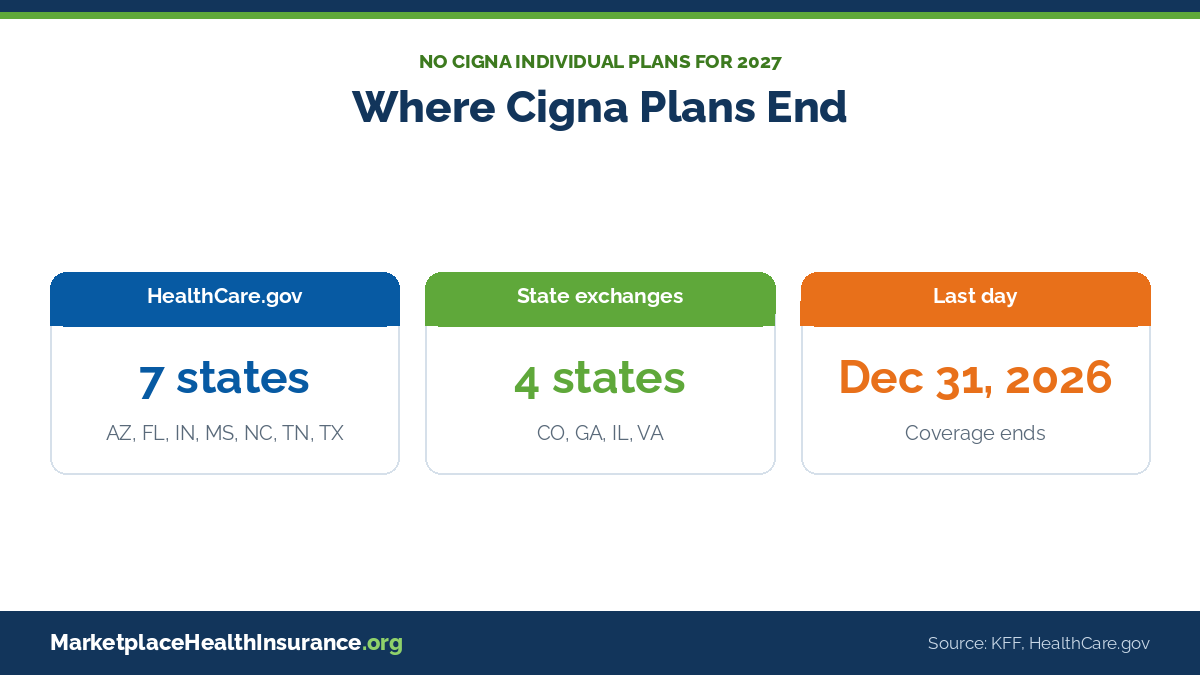
Cigna health insurance plans 2027 is a short story with a big impact: Cigna will not sell individual and family health plans for 2027. The company is leaving the individual market in all 11 states where it sold Marketplace coverage, and the exit covers plans bought through an exchange as well as plans bought directly from Cigna.
Losing your Cigna plan?
Compare 2027 Replacement Plans
Enter your ZIP code to see which insurers sell 2027 Marketplace plans in your county and your estimated premium tax credit.
Plans, prices and savings vary by ZIP code, age, household size and income.
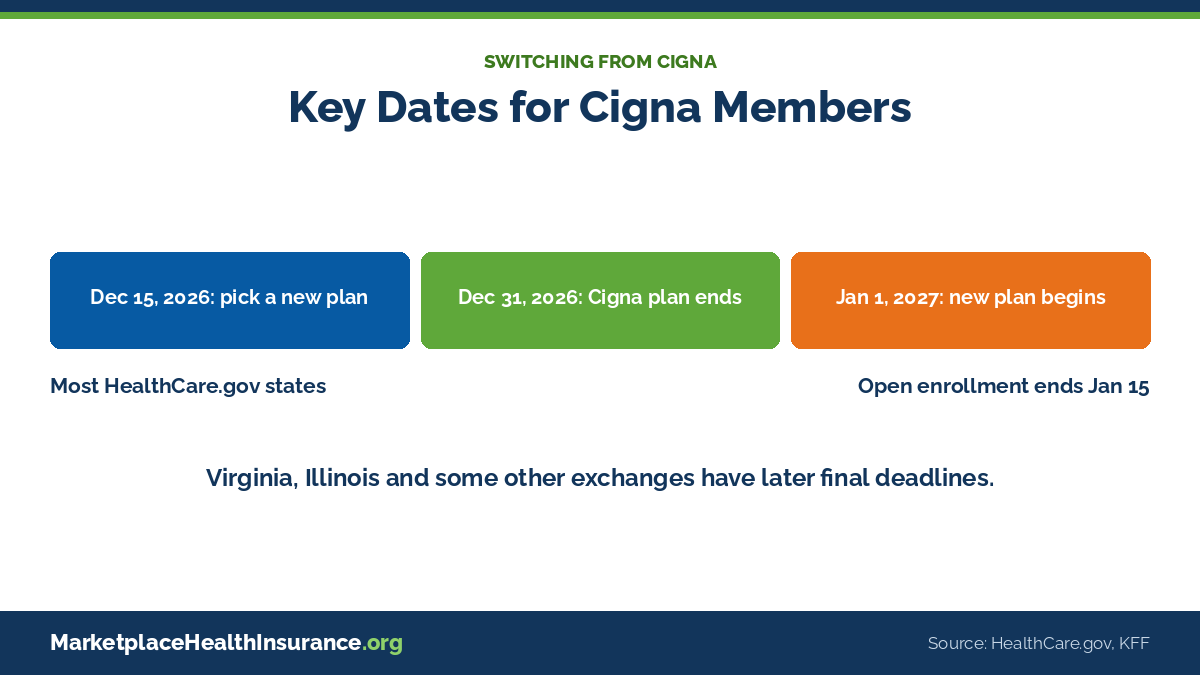
If you have a Cigna individual plan today, your coverage continues through December 31, 2026 as long as premiums are paid. After that, you need a plan from a different insurer. This guide lists the affected states, explains what happens to your current plan, and walks through choosing a replacement for 2027. You can also compare 2027 Marketplace plans by ZIP code at any time.
The short answer
Cigna is not offering individual or family health plans for 2027 in any of its 11 states: Arizona, Colorado, Florida, Georgia, Illinois, Indiana, Mississippi, North Carolina, Tennessee, Texas and Virginia. Current Cigna plans end December 31, 2026. Pick a plan from another insurer by December 15, 2026 in most states to avoid a gap on January 1, 2027.
Cigna Is Leaving the Individual Market for 2027
Cigna announced in spring 2026 that it would stop selling individual and family medical plans after the 2026 plan year. KFF, which tracks insurer participation, confirms that Cigna will exit all 11 states where it currently participates, both on and off the exchange. Industry coverage puts the number of affected Cigna individual members at roughly 369,000.
Cigna individual plans at a glance
11
States Cigna is leaving
Dec 31, 2026
Last day of Cigna individual coverage
Dec 15, 2026
Pick a new plan for a Jan 1 start (most states)
On and off exchange
Both types of Cigna plans end
Cigna is one of 11 insurers that announced an exit from at least one state Marketplace for 2027, while seven insurers announced they are entering new states. That means the list of companies selling in your county may look different this year, so a fresh comparison matters even if you were not a Cigna member.
States Where Cigna Plans End
The table shows each affected state, the marketplace residents use, and the last day of 2027 open enrollment. Most affected states use HealthCare.gov; four run their own exchange.
| State | Where to shop | Open enrollment ends |
|---|---|---|
| Arizona | HealthCare.gov | Jan 15, 2027 |
| Colorado | Connect for Health Colorado | Jan 15, 2027 |
| Florida | HealthCare.gov | Jan 15, 2027 |
| Georgia | Georgia Access | Jan 15, 2027 |
| Illinois | Get Covered Illinois | Check Get Covered Illinois |
| Indiana | HealthCare.gov | Jan 15, 2027 |
| Mississippi | HealthCare.gov | Jan 15, 2027 |
| North Carolina | HealthCare.gov | Jan 15, 2027 |
| Tennessee | HealthCare.gov | Jan 15, 2027 |
| Texas | HealthCare.gov | Jan 15, 2027 |
| Virginia | Virginia’s Insurance Marketplace | Jan 29, 2027 |
Sources: KFF insurer participation tracker (Oct 2026), HealthCare.gov, state exchanges. Enroll by Dec 15, 2026 in HealthCare.gov states for a Jan 1 start.
State guides cover local insurers and dates in more detail, including Arizona, Texas, and Virginia. Arizona shoppers can also read our page on Cigna health insurance in Arizona.
What Happens to Your Current Cigna Plan
Your Cigna plan stays in force through the end of 2026 if you keep paying premiums. Claims for care received in 2026 are still handled under that plan. What changes is January 1, 2027: there is no Cigna individual plan to renew into.
Exchange plan, HealthCare.gov state
The marketplace may move you into a similar plan from another insurer where state rules allow. That plan may cost more or use a different network, so review it before January.
Georgia Access
Georgia moves members of exiting insurers into another insurer’s plan, but you can choose a different plan yourself during open enrollment.
Colorado and Illinois
Connect for Health Colorado and Get Covered Illinois tell Cigna members to choose a new plan themselves rather than wait for an automatic move.
Bought directly from Cigna
There is no marketplace to move you. You need to buy a new plan, on or off the exchange, to stay covered.
Do not count on an automatic move
Even where a marketplace places you in a new plan, that plan was chosen by a formula, not by your doctors or prescriptions. Actively choosing a plan by December 15, 2026 is the safest way to keep your care on track for January 1, 2027.
Employer plans administered or insured by Cigna are not part of this exit. The change applies to individual and family coverage that people buy for themselves.

From the agent’s desk
Cigna members often assume the plan will simply renew, as it has in past years. For 2027 there is no Cigna individual plan to renew into, so the January 1 start depends on choosing a new insurer by the December 15 cutoff in most states.
Russell Noga, Licensed Insurance Agent
How to Choose a Replacement Plan for 2027
1
Confirm your exchange and deadline. Use the table above or our open enrollment guide to find your state’s dates.
2
List your must-haves. Write down your doctors, hospitals, prescriptions and any planned care for 2027.
3
Update your 2027 income estimate. Premium tax credits depend on projected income, and there is no longer a cap on repaying excess credits.
4
Compare insurers in your ZIP code. Look at bronze, silver and gold plans from every insurer selling in your county.
5
Check networks and drug lists. Search each plan’s 2027 provider directory and formulary before you choose.
6
Enroll and pay the first premium. A new plan does not start until the first payment is made.
Many former Cigna members will compare plans from Blue Cross Blue Shield companies, Ambetter, UnitedHealthcare, Oscar or regional insurers, depending on the county. Which companies sell in your area varies, so check by ZIP code rather than relying on a national list.
Need a new plan after Cigna?
Call a Licensed Agent Now
A licensed agent can compare 2027 plans from the insurers in your ZIP code and check your premium tax credit at no cost.
TTY 711 · Mon–Fri 8am–8pm ET · No obligation to enroll
What 2027 Coverage Will Cost
Moving off Cigna happens in a year when prices are already rising. KFF reports that the average benchmark silver premium is up 13% for 2027, with an 11% average increase in HealthCare.gov states and 16% in state-run marketplaces. The national average benchmark silver premium for a 40-year-old is about $703 a month before any tax credit.
| Household size | 100% FPL | 400% FPL (tax credit limit) |
|---|---|---|
| 1 | $15,960 | $63,840 |
| 2 | $21,640 | $86,560 |
| 3 | $27,320 | $109,280 |
| 4 | $33,000 | $132,000 |
2026 federal poverty guidelines, used for 2027 coverage in 48 states and DC. Source: HealthCare.gov.
The enhanced premium tax credits expired at the end of 2025, so the original ACA rules apply for 2027. Households with income from 100% to 400% of the federal poverty level can qualify for a premium tax credit, and those up to 250% may get lower deductibles on silver plans. Above 400%, there is no tax credit, which makes comparing metal levels especially important.
Missed the Deadline? Special Enrollment After a Cigna Exit
Losing a plan because the insurer left the market generally counts as a qualifying life event, which opens a Special Enrollment Period, usually 60 days. Some exchanges set specific windows. For example, Connect for Health Colorado has said affected Cigna customers can enroll until March 1, 2027.
Choosing by December 15
✔
New coverage starts January 1, 2027
✔
Time to compare networks and drug lists
✔
No gap for ongoing care or prescriptions
Waiting for a special enrollment window
✕
Coverage that starts after January 1 leaves a gap
✕
Deductibles and out-of-pocket limits reset on a new plan
✕
Fewer days to fix paperwork or payment problems
For a broader look at your options, see our health insurance guide and the health insurance marketplace hub, which links to every state page.
Deadline December 15
Find a New Plan Before Cigna Ends
Enroll by December 15, 2026 in most states so your new coverage starts January 1, 2027 with no gap.
Plans, prices and savings vary by ZIP code, age, household size and income.
Cigna Health Insurance Plans FAQs
➤ Is Cigna offering individual health insurance in 2027?
No. Cigna is leaving the individual and family market in all 11 states where it sold for 2027, both on and off the exchange.
➤ Which states is Cigna leaving?
Arizona, Colorado, Florida, Georgia, Illinois, Indiana, Mississippi, North Carolina, Tennessee, Texas and Virginia.
➤ When does my Cigna plan end?
Cigna individual plans stay in effect through December 31, 2026 as long as premiums are paid.
➤ Will I be moved to a new plan automatically?
It depends on the state. Some marketplaces, such as Georgia Access, move members to another insurer’s plan; Colorado and Illinois tell members to choose themselves. Plans bought directly from Cigna are not moved.
➤ Do I get a special enrollment period?
Losing coverage because an insurer leaves generally qualifies you for a Special Enrollment Period, but coverage that starts after January 1 can leave a gap.
➤ Is my Cigna employer plan affected?
No. The exit applies to individual and family plans, not employer coverage.
➤ Can I still get a premium tax credit with a new insurer?
Yes, if your household income is between 100% and 400% of the federal poverty level and you meet the other rules.
Free Plan Comparison
Call a Licensed Agent Now
Compare 2027 Marketplace plans and savings with a licensed agent in one call.
TTY 711 · Mon–Fri 8am–8pm ET · No obligation to enroll
About the Author: Russell Noga
Russell Noga is a licensed insurance agent and the founder of ZRN Health & Financial Services, LLC. He has helped people compare health and supplemental insurance for more than 16 years and reviews every page on MarketplaceHealthInsurance.org before it is published.
MarketplaceHealthInsurance.org is privately owned and operated by ZRN Health & Financial Services, LLC, based in Austin, Texas. We are not HealthCare.gov or any state exchange and are not connected with or endorsed by any government agency. Premiums, subsidies and plan availability vary by state, ZIP code, age, household size and income. Calls may be answered by a licensed insurance agent from a partner agency.