


Reviewed by Russell Noga, Licensed Insurance Agent · Updated November 20, 2026
What is ACA insurance? It is individual and family health coverage that follows the rules of the Affordable Care Act, the 2010 law many people call Obamacare. Most people buy it through HealthCare.gov or a state-run exchange, where these plans are known as Marketplace plans, and many qualify for a tax credit that lowers the monthly premium.
2027 ACA plans
Compare ACA Insurance Plans Near You
See 2027 premiums, deductibles and your estimated tax credit from insurers in your ZIP code.
Plans, prices and savings vary by ZIP code, age, household size and income.
ACA plans are built for people who do not get affordable coverage through a job, Medicare or Medicaid: the self-employed, early retirees, gig workers, people between jobs and families whose employer coverage is too expensive. This guide covers how the plans work for 2027, what they must include and how to sign up. You can also compare 2027 ACA plans in your ZIP code at any time.
The short answer
ACA insurance is private health coverage sold under Affordable Care Act rules. Every plan covers essential health benefits, cannot deny you for a pre-existing condition and is grouped into bronze, silver, gold or platinum levels. Households with income from 100% to 400% of the federal poverty level may get a premium tax credit for 2027.
ACA Insurance Explained
Private insurance companies design and sell ACA plans, but the law sets the ground rules. The plans are sold on the federal or state marketplace, and many are also available directly from insurers. Buying through the Marketplace is the only way to receive the premium tax credit. Our ACA insurance section collects every guide on the topic in one place.
ACA insurance at a glance
4
Metal levels: bronze, silver, gold, platinum
100%-400%
FPL range for premium tax credits in 2027
Nov 1
Open enrollment start date each year
Age 26
Young adults can stay on a parent’s plan
The term ACA insurance, Obamacare and Marketplace plan usually describe the same coverage. Our Obamacare guide covers the history of the law, and the health insurance marketplace section explains how the exchanges work state by state.
Where ACA plans are sold
Most states use HealthCare.gov, the federal marketplace. About 20 states and the District of Columbia run their own exchanges, such as Covered California or NY State of Health, with their own websites and sometimes their own deadlines. The plans follow the same core ACA rules either way. Which insurers sell in your area, how many plans they offer and what they charge all depend on your county, so two neighbors in different counties can see very different choices.
What Every ACA Plan Must Cover
ACA-compliant plans must include ten categories of essential health benefits. Exact copays and drug lists vary, but no Marketplace plan can leave these out.
- Doctor visits and outpatient care, including care you receive without being admitted to a hospital.
- Emergency services and hospital stays, including surgery.
- Pregnancy, maternity and newborn care.
- Mental health and substance use disorder services, including counseling.
- Prescription drugs on the plan’s drug list.
- Rehabilitative and habilitative services, such as physical therapy.
- Lab services, preventive and wellness care, and pediatric care, including children’s dental and vision.
Pre-existing conditions
An ACA plan cannot turn you down, charge you more or exclude coverage because of a health condition you had before enrolling. Premiums can vary only by age, location, tobacco use and whether the plan covers an individual or a family.
Metal Levels: Bronze, Silver, Gold and Platinum
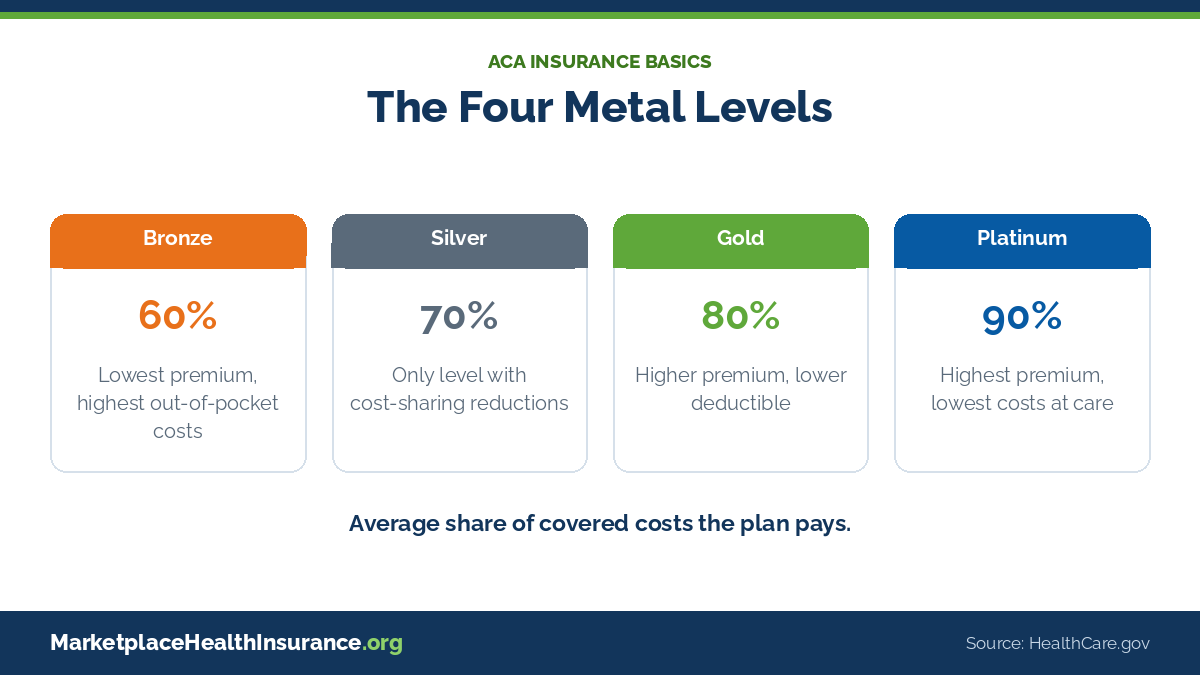
Metal levels describe how you and the plan split costs, not the quality of care. A plan with a lower premium usually has a higher deductible, and the reverse.
| Metal level | Plan pays on average | Best fit |
|---|---|---|
| Bronze | About 60% | Healthy people who mainly want protection from big bills |
| Silver | About 70% | People who qualify for cost-sharing reductions |
| Gold | About 80% | Regular doctor visits or ongoing prescriptions |
| Platinum | About 90% | Frequent care; not sold in every area |
Percentages are the average share of covered costs a plan pays for a typical population.
Catastrophic plans are a fifth option for people under 30 and some who qualify for a hardship exemption. They have very low premiums and very high deductibles, and they cannot be paired with a premium tax credit.

From the agent’s desk
The metal level with the lowest premium is not always the cheapest choice. For someone who sees a specialist or fills monthly prescriptions, a gold plan can cost less over a full year than a bronze plan once the deductible is counted. Comparing total yearly cost gives a truer picture than the monthly price alone.
Russell Noga, Licensed Insurance Agent
Who Qualifies for ACA Savings in 2027
The enhanced premium tax credits that applied from 2021 through 2025 expired, so the original ACA rules apply for 2027. Tax credits are available when household income is between 100% and 400% of the federal poverty level and you do not have access to affordable job-based coverage, Medicare or Medicaid.
| Household size | Lower limit (100% FPL) | Upper limit (400% FPL) |
|---|---|---|
| 1 | $15,960 | $63,840 |
| 2 | $21,640 | $86,560 |
| 3 | $27,320 | $109,280 |
| 4 | $33,000 | $132,000 |
2026 poverty guidelines used for 2027 coverage; Alaska and Hawaii are higher. Source: HealthCare.gov.
In states that expanded Medicaid, adults with income up to 138% of the poverty level usually qualify for Medicaid instead. Silver plans also come with cost-sharing reductions, which lower deductibles and copays, for incomes up to 250% of the poverty level.
2027 Marketplace Plans
Call a Licensed Agent Now
A licensed agent can compare 2027 Marketplace plans in your ZIP code and check your premium tax credit at no cost.
TTY 711 · Mon–Fri 8am–8pm ET · No obligation to enroll
ACA Insurance Compared With Other Coverage
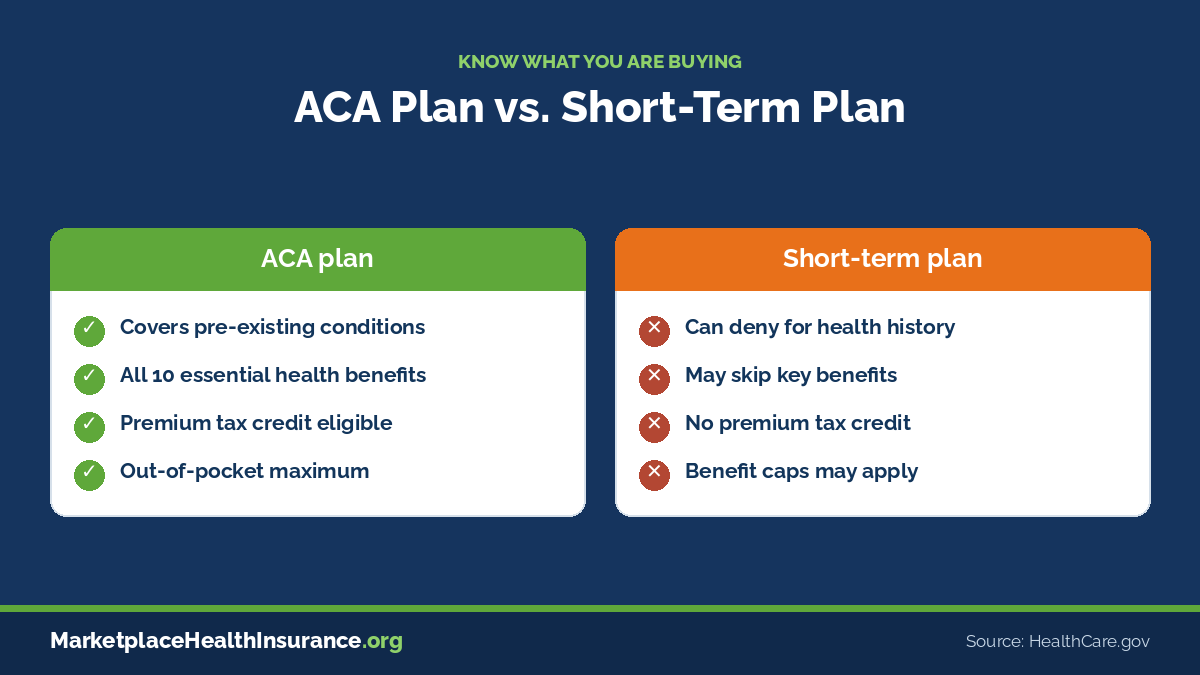
ACA Marketplace plans
✔
Must cover pre-existing conditions.
✔
Include all ten essential health benefits.
✔
Eligible for premium tax credits.
✔
Annual out-of-pocket maximum limits your spending.
Short-term and non-ACA plans
✕
Can deny coverage based on health history.
✕
May exclude maternity, mental health or prescriptions.
✕
No premium tax credit.
✕
Benefit caps can leave large bills unpaid.
Job-based coverage also follows many ACA rules. If your employer’s plan is considered affordable, you generally cannot get a Marketplace tax credit. Our health insurance hub compares the main options in more detail.
How to Enroll in ACA Insurance
1
Check the calendar. Open enrollment for 2027 runs November 1, 2026 to January 15, 2027 in HealthCare.gov states; choose by December 15 for a January 1 start.
2
Estimate your 2027 income. Your tax credit is based on expected income, and there is no longer a cap on paying back an overpayment at tax time.
3
Compare plans by total cost. Look at the premium, deductible, out-of-pocket maximum, network and drug list together.
4
Apply and choose a plan. Apply through HealthCare.gov, your state exchange or a licensed agent who can enroll you in Marketplace plans.
5
Pay the first premium. Coverage starts only after the insurer receives your first payment.
Outside open enrollment, you need a qualifying life event such as losing other coverage, moving or having a baby. See the open enrollment dates and deadlines for every state.
Open enrollment ends January 15
Find the Right ACA Plan for 2027
Enter your ZIP code to compare bronze, silver and gold plans side by side.
Plans, prices and savings vary by ZIP code, age, household size and income.
ACA Insurance FAQs
➤ What is ACA insurance?
ACA insurance is individual and family health coverage that meets Affordable Care Act rules. It covers essential health benefits, protects people with pre-existing conditions and is sold through HealthCare.gov and state marketplaces.
➤ Is ACA insurance the same as Obamacare?
Yes. Obamacare is a common nickname for the Affordable Care Act, and ACA plans, Obamacare plans and Marketplace plans generally refer to the same coverage.
➤ Is ACA insurance free?
Not usually. Some people with low incomes may find plans with a very low premium after the tax credit, but most enrollees pay a monthly premium plus deductibles and copays.
➤ Who can buy ACA insurance?
Most U.S. citizens and lawfully present residents who live in the state and are not incarcerated can buy a Marketplace plan. Tax credit eligibility has additional income and immigration rules for 2027.
➤ Can I get ACA insurance outside open enrollment?
Only with a Special Enrollment Period, usually triggered by a life event such as losing coverage, marriage, a new baby or a move. You generally have 60 days to enroll.
➤ What is the difference between ACA insurance and Medicaid?
Medicaid is a public program for people with low incomes, run by each state. ACA insurance is private coverage bought through the Marketplace. In states that expanded Medicaid, adults up to 138% of the poverty level usually qualify for Medicaid rather than a tax credit.
➤ Does ACA insurance cover pre-existing conditions?
Yes. ACA plans cannot deny coverage or charge more because of your health history.
Free Plan Comparison
Call a Licensed Agent Now
Compare 2027 Marketplace plans and savings with a licensed agent in one call.
TTY 711 · Mon–Fri 8am–8pm ET · No obligation to enroll
About the Author: Russell Noga
Russell Noga is a licensed insurance agent and the founder of ZRN Health & Financial Services, LLC. He has helped people compare health and supplemental insurance for more than 16 years and reviews every page on MarketplaceHealthInsurance.org before it is published.
MarketplaceHealthInsurance.org is privately owned and operated by ZRN Health & Financial Services, LLC, based in Austin, Texas. We are not HealthCare.gov or any state exchange and are not connected with or endorsed by any government agency. Premiums, subsidies and plan availability vary by state, ZIP code, age, household size and income. Calls may be answered by a licensed insurance agent from a partner agency.