


Reviewed by Russell Noga, Licensed Insurance Agent · Updated November 19, 2026
The Arizona health insurance marketplace 2027 has some of the steepest price increases in the country. The average individual-market rate change in Arizona is about 28% before premium tax credits, more than double the national rise in the benchmark silver premium. At the same time, Cigna is leaving, so Arizona shoppers have six insurers to choose from on HealthCare.gov.
Arizona 2027 plans are live
Compare Arizona Marketplace Plans in Your ZIP Code
See 2027 premiums, deductibles and networks from the six Arizona insurers, with your estimated tax credit applied.
Plans, prices and savings vary by ZIP code, age, household size and income.
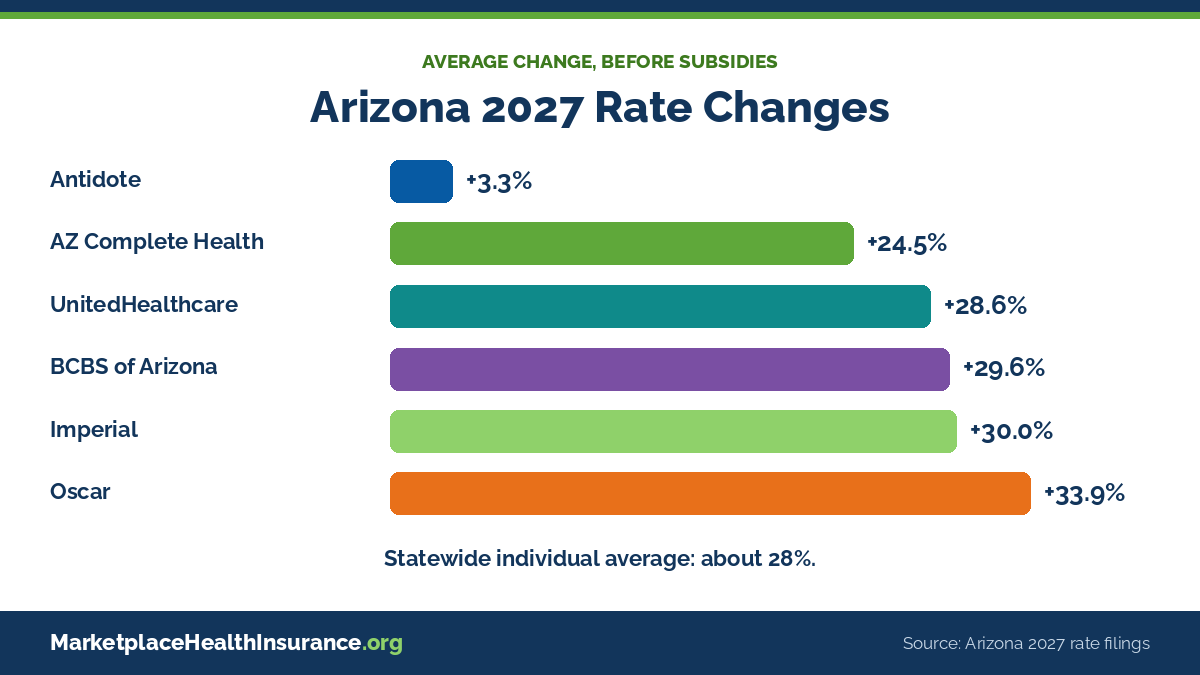
Big increases make plan comparison more valuable, not less. Rate changes in Arizona range from about 3% at Antidote to about 34% at Oscar, so the plan that was cheapest last year may not be this year. This guide covers Arizona’s 2027 open enrollment dates, every insurer’s filed change, what Cigna members should do, how AHCCCS and the premium tax credit work, and how to keep your cost down. To see real quotes, compare Arizona Marketplace plans by ZIP code.
The short answer
Arizona uses HealthCare.gov. Open enrollment for 2027 runs November 1, 2026 to January 15, 2027; choose a plan by December 15, 2026 for January 1 coverage. Six insurers sell 2027 plans: Antidote, Blue Cross Blue Shield of Arizona, Arizona Complete Health (Ambetter), Imperial, Oscar and UnitedHealthcare. Cigna is leaving. The average rate increase is about 28% before subsidies.
Open Enrollment 2027 Dates in Arizona
Arizona does not operate its own exchange, so residents use HealthCare.gov and the federal calendar applies. A rule that would have shortened the 2027 enrollment window was vacated in court, so the usual dates stand.
| Date | What happens |
|---|---|
| November 1, 2026 | Open enrollment opens with 2027 Arizona plans and prices |
| December 15, 2026 | Deadline for coverage that starts January 1, 2027 |
| December 31, 2026 | Cigna individual coverage in Arizona ends |
| January 15, 2027 | Last day to enroll; coverage starts February 1, 2027 |
Outside these dates you need a qualifying life event, such as losing job-based coverage or moving.
See every national and state-exchange deadline on our Marketplace open enrollment 2027 page.
Arizona Marketplace Insurers and 2027 Rate Changes
Arizona had seven insurers on the Marketplace for 2026 and has six for 2027. Each one filed a different average change, and the spread is unusually wide:
| Insurer | Average 2027 change (before subsidies) |
|---|---|
| Antidote Health Plan of Arizona | About +3.3% |
| Arizona Complete Health (Ambetter, Health Net of Arizona) | About +24.5% |
| UnitedHealthcare of Arizona | About +28.6% |
| Blue Cross Blue Shield of Arizona | About +29.6% |
| Imperial Insurance Companies | About +30.0% |
| Oscar Health Plan | About +33.9% |
| Cigna Healthcare of Arizona | Leaving the individual market |
Averages across all plans; your own change depends on plan, age and county. The statewide average is about 28%.
Oscar has the largest Arizona enrollment and also the largest filed increase, which means many Arizonans will see a big renewal notice. Antidote’s small increase may make it worth a look if its network fits your doctors. For carrier changes in other states, see our Marketplace health insurance companies guide.

From the agent’s desk
In a year when Arizona insurers raised rates anywhere from about 3% to 34%, staying put is the most expensive default. Comparing the renewed plan with the lowest-priced option in the same metal level, and checking the network, regularly turns up savings worth hundreds of dollars a year.
Russell Noga, Licensed Insurance Agent
Arizona Prices in 2027 and Why They Jumped
Arizona 2027 in numbers
About 28%
Average Arizona rate increase, before subsidies
13%
National average benchmark silver increase
6
Insurers selling 2027 plans
357,144
Arizonans who chose a plan for 2026
Arizona lost a large share of its Marketplace enrollees after the enhanced federal subsidies ended at the end of 2025. Paid enrollment fell by nearly 30% year over year by February 2026. When healthier people leave, the remaining risk pool costs more to cover, and insurers price that into the next year’s rates along with rising provider prices and inflation.
The national picture is explained in our why is health insurance going up in 2027 guide.
Subsidies and AHCCCS in Arizona for 2027
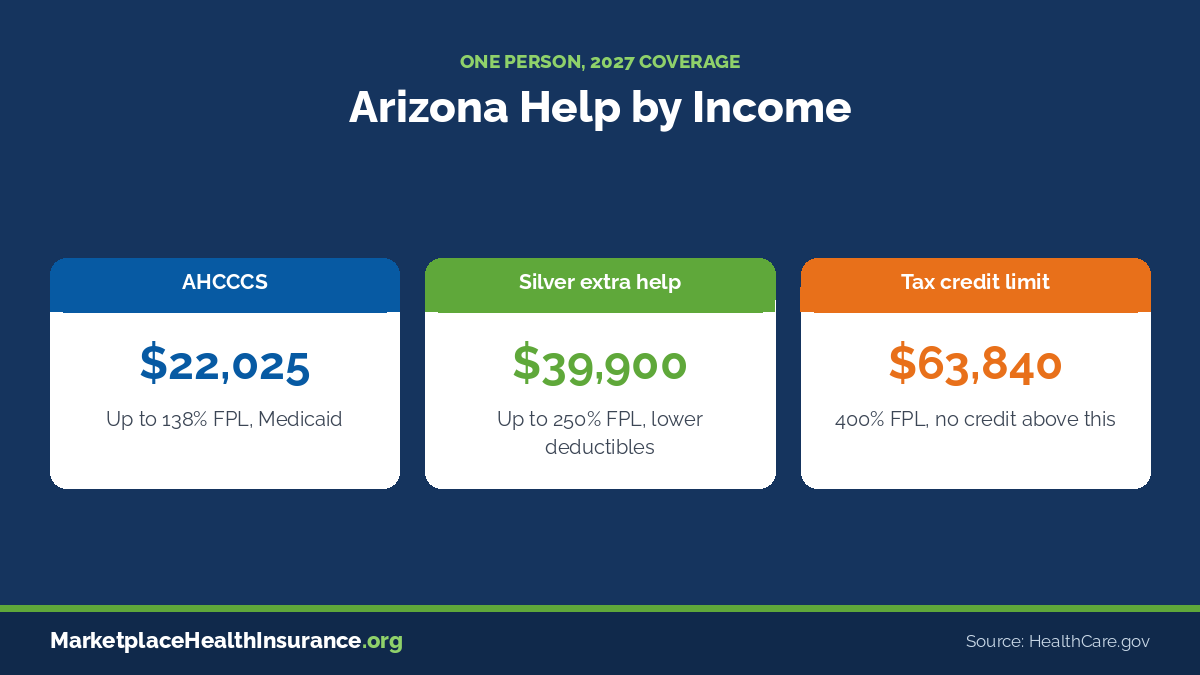
Arizona’s Medicaid program is called AHCCCS (the Arizona Health Care Cost Containment System). Arizona expanded Medicaid, so most adults with income up to 138% of the federal poverty level, about $22,025 for one person, qualify for AHCCCS instead of a Marketplace plan.
| Household | Medicaid line (138% FPL) | Tax credit upper limit (400% FPL) |
|---|---|---|
| 1 person | $22,025 | $63,840 |
| 2 people | $29,863 | $86,560 |
| 4 people | $45,540 | $132,000 |
2026 poverty guidelines, used for 2027 coverage.
The good news inside a bad price year
Premium tax credits are tied to the benchmark silver premium. When Arizona’s benchmark price rises sharply, eligible households usually get a larger credit too, so the net price may rise far less than 28%. Households above 400% FPL get no credit for 2027 and feel the full increase.
Arizona has no state premium subsidy for 2027. See our Obamacare subsidies 2027 guide for full charts.
2027 Marketplace Plans
Call a Licensed Agent Now
A licensed agent can compare 2027 Marketplace plans in your ZIP code and check your premium tax credit at no cost.
TTY 711 · Mon–Fri 8am–8pm ET · No obligation to enroll
What Cigna Members in Arizona Should Do
Cigna is leaving the individual market in all 11 states where it sold, including Arizona. Its Arizona plans end December 31, 2026.
1
Read your exit notice. It explains the end date and any plan HealthCare.gov may suggest.
2
Check your doctors. Search the six remaining insurers’ networks for your providers and hospital.
3
Compare after-credit prices. Look at bronze, silver and gold, since the credit can be used on any of them.
4
Choose by December 15. That gives you new coverage on January 1, 2027 with no gap.
Losing coverage because an insurer leaves the market can also qualify you for a Special Enrollment Period, but relying on that window risks a gap. Members who also had Aetna before its 2025 exit, or who were moved from discontinued Blue Cross Blue Shield of Arizona PPO plans for 2026, may be on their third plan in three years, so a careful network check is worth the extra time.
How to Keep Your Arizona Cost Down in 2027
Moves that often save money
✔
Switching insurers when your current one filed a large increase.
✔
Choosing silver if income is at or below 250% FPL.
✔
Checking gold, which can price close to silver.
✔
Updating your 2027 income so the credit is right.
Moves that often cost money
✕
Letting your plan auto-renew without comparing.
✕
Choosing on premium alone and ignoring the deductible.
✕
Underestimating income, since repayment caps are gone.
✕
Waiting until January and starting coverage February 1.
Arizona checklist
- ✔Find out your insurer’s 2027 increase.
- ✔Confirm your doctors in any plan you consider.
- ✔Check AHCCCS eligibility if your income dropped.
- ✔Pick a plan by December 15, 2026.
Official enrollment is on HealthCare.gov. For other state guides, visit our health insurance marketplace hub.
Rates up about 28%
Do Not Let Your Arizona Plan Auto-Renew
Enter your ZIP code to compare 2027 plans and savings before the December 15 deadline.
Plans, prices and savings vary by ZIP code, age, household size and income.
Arizona Health Insurance Marketplace 2027 FAQs
➤ Does Arizona have a state health insurance exchange?
No. Arizona residents enroll in Marketplace plans through HealthCare.gov.
➤ When is open enrollment in Arizona for 2027?
November 1, 2026 to January 15, 2027. Choose by December 15, 2026 for coverage starting January 1, 2027.
➤ How much are Arizona health insurance rates going up in 2027?
The average individual-market increase is about 28% before premium tax credits. Insurer averages range from about 3% for Antidote to about 34% for Oscar.
➤ Which insurers sell Marketplace plans in Arizona for 2027?
Antidote, Blue Cross Blue Shield of Arizona, Arizona Complete Health (Ambetter), Imperial, Oscar and UnitedHealthcare. Availability varies by county.
➤ Is Cigna leaving Arizona?
Yes. Cigna is leaving the individual market in all 11 states where it sold, including Arizona. Cigna members should choose a new plan by December 15, 2026.
➤ Did Arizona expand Medicaid?
Yes. Arizona’s Medicaid program, AHCCCS, covers most adults with income up to 138% of the federal poverty level, about $22,025 for one person.
➤ Will my subsidy go up if Arizona premiums rise?
Often, yes. The premium tax credit is based on the benchmark silver premium, so eligible households between 100% and 400% FPL usually see a larger credit when that premium rises.
Free Plan Comparison
Call a Licensed Agent Now
Compare 2027 Marketplace plans and savings with a licensed agent in one call.
TTY 711 · Mon–Fri 8am–8pm ET · No obligation to enroll
About the Author: Russell Noga
Russell Noga is a licensed insurance agent and the founder of ZRN Health & Financial Services, LLC. He has helped people compare health and supplemental insurance for more than 16 years and reviews every page on MarketplaceHealthInsurance.org before it is published.
MarketplaceHealthInsurance.org is privately owned and operated by ZRN Health & Financial Services, LLC, based in Austin, Texas. We are not HealthCare.gov or any state exchange and are not connected with or endorsed by any government agency. Premiums, subsidies and plan availability vary by state, ZIP code, age, household size and income. Calls may be answered by a licensed insurance agent from a partner agency.