


Reviewed by Russell Noga, Licensed Insurance Agent · Updated November 20, 2026
The Blue Cross Blue Shield marketplace 2027 lineup is not one insurance company. Blue Cross Blue Shield is a national association of independent, locally run companies, and each one decides whether it sells on the Marketplace in its own state, which counties it covers and what its plans cost. That is why a Blue plan in Texas, a Blue plan in North Dakota and a Blue plan in Louisiana can look very different.
2027 Blue plans are listed
See Blue Cross Blue Shield Plans in Your ZIP Code
Compare 2027 Blue plans side by side with every other Marketplace insurer in your area, with your estimated savings.
Plans, prices and savings vary by ZIP code, age, household size and income.
This guide explains how the Blue companies fit into the 2027 Marketplace, what is known about their 2027 prices, how to judge a Blue network and how to enroll before the deadline. You can also compare Marketplace health insurance plans from every insurer in your ZIP code, Blue and non-Blue, in a few minutes.
The short answer
Blue Cross Blue Shield companies sell Marketplace plans in most states for 2027, but each Blue company is separate and sets its own counties, networks and prices. Open enrollment on HealthCare.gov runs November 1, 2026 to January 15, 2027; pick a plan by December 15 for January 1 coverage. Premium tax credits apply to Blue plans the same as any other Marketplace plan.
How Blue Cross Blue Shield Works on the Marketplace
Every Blue company licenses the Blue Cross and Blue Shield names, but it is its own business with its own board, provider contracts and rate filings. On the health insurance marketplace, you only see the Blue company licensed for your area. A family in Dallas sees Blue Cross and Blue Shield of Texas; a family in Fargo sees Blue Cross Blue Shield of North Dakota.
Independent local companies
Each Blue plan files its own 2027 rates with its state, so price changes vary widely from one state to the next.
Large parent groups
Some Blues belong to bigger groups. Anthem plans are part of Elevance Health, and Health Care Service Corporation runs the Blue plans in Illinois, Montana, New Mexico, Oklahoma and Texas.
Local networks
Marketplace Blue plans usually use a narrower network than Blue employer plans. The Blue name does not guarantee every doctor in the state is covered.
BlueCard travel access
Many Blue plans offer some coverage through other Blue companies when you are out of state, often limited to emergencies on Marketplace HMO plans. Check your plan’s documents.
Because each company is separate, the most useful page is usually your state’s own Blue guide, such as Blue Cross Blue Shield of Texas or Blue Cross Blue Shield of Louisiana.
Where Blue Plans Are Selling for 2027
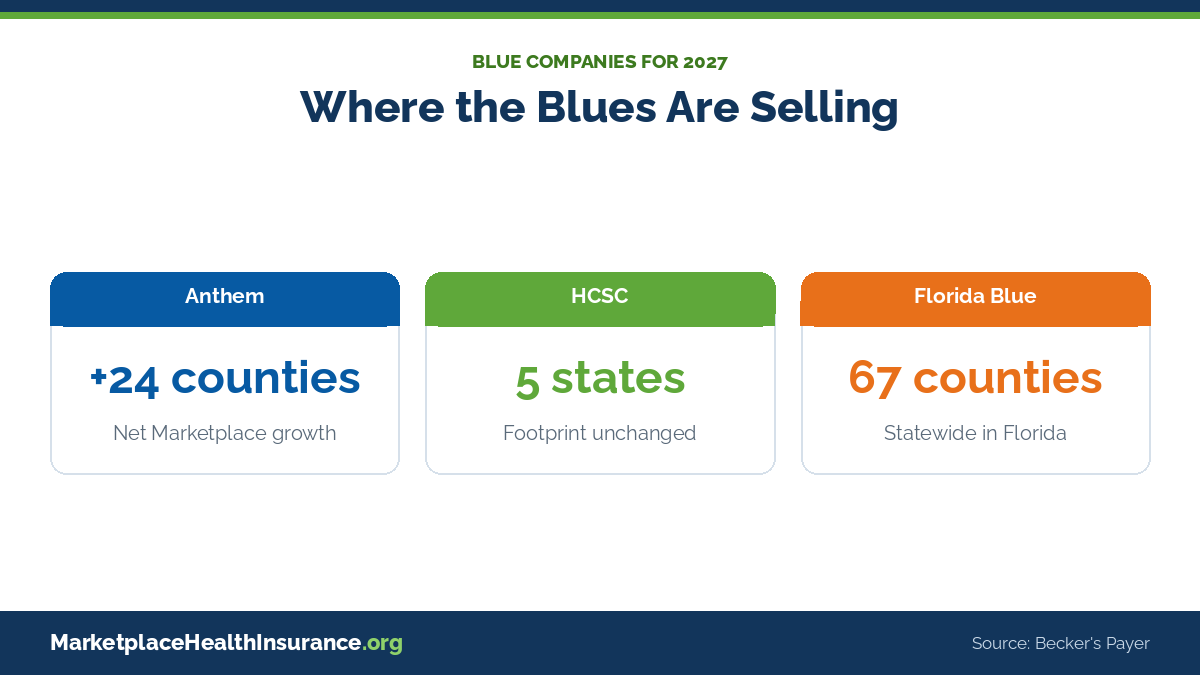
Insurer exits are a big story for 2027, but the major Blue companies are largely staying put. Industry reporting on 2027 Marketplace footprints names no Blue company leaving the individual market, and several are holding or growing their service areas.
| Blue company or group | 2027 Marketplace footprint (reported) |
|---|---|
| Elevance Health (Anthem) | Net increase of 24 counties across its Marketplace states |
| Health Care Service Corporation | Keeping its current footprint in five states |
| Florida Blue | Still selling in all 67 Florida counties |
| Other Blue companies | Check your state; most continue to sell, county coverage can change |
Source: Becker’s Payer, October 2026. Availability is by county; confirm with your ZIP code.
Not every Blue sells on the exchange
A few Blue companies sell individual plans only outside the Marketplace in some years or areas. Premium tax credits can only be used on plans bought through HealthCare.gov or your state exchange, so an off-exchange Blue plan means paying the full price.
Other insurers are changing more. Cigna is leaving the individual market in all 11 of its states for 2027, and 11 carriers exited at least one state. If you are moving from a departing insurer, a Blue plan is often one of the options in your county.

From the agent’s desk
Blue plans are often treated as the safe default, but on the Marketplace the Blue network can be smaller than the one people remember from a job-based plan. Searching the specific 2027 network for each doctor before enrolling prevents most surprise bills.
Russell Noga, Licensed Insurance Agent
What Blue Plans Cost in 2027
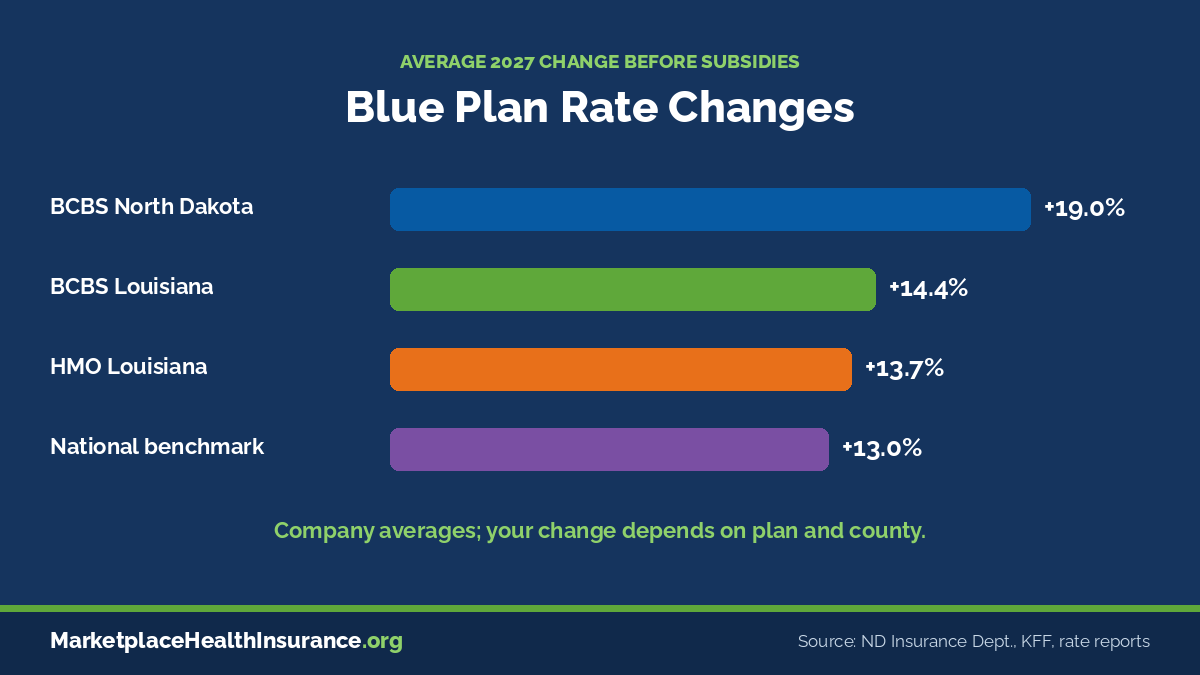
There is no single Blue Cross Blue Shield price. Each company’s 2027 rate change was set by its own state. A few approved or filed examples show the range:
Selected 2027 Blue rate changes (individual market)
+19.0%
Blue Cross Blue Shield of North Dakota, approved average
+14.4%
Blue Cross and Blue Shield of Louisiana, reported average
+13.7%
HMO Louisiana (Louisiana Blue), reported average
+13%
National average benchmark silver change, all insurers
Those averages are before any premium tax credit. Nationally, the average benchmark silver premium for a 40-year-old is $703 a month for 2027 before savings, up 13% from 2026. Most enrollees pay far less after their tax credit, but the enhanced credits expired at the end of 2025, so households above 400% of the federal poverty level, about $63,840 for one person, get no premium tax credit for 2027. Our Obamacare subsidies 2027 guide shows the income limits in full.
Blue Cross Blue Shield Plan Types and Metal Levels
Blue Marketplace plans follow the same ACA rules as every other exchange plan. They cover the 10 essential health benefits, cannot deny you for a pre-existing condition and come in standard metal levels.
| Metal level | Plan pays (average) | Usually fits |
|---|---|---|
| Bronze | About 60% | Low monthly premium, rarely use care |
| Silver | About 70% | Income under 250% FPL (cost-sharing reductions) |
| Gold | About 80% | Regular prescriptions or ongoing care |
| Platinum | About 90% | Offered by some Blues in some states |
Network type varies: many Blue Marketplace plans are HMOs or EPOs; PPOs are less common on the exchange.
Why shoppers pick Blue plans
✔
Long-standing local provider relationships in many states
✔
Often available in rural counties where few insurers sell
✔
Same tax credits and ACA protections as any Marketplace plan
What to watch
✕
Marketplace networks can be narrower than Blue employer plans
✕
Rates vary widely; some Blues raised 2027 prices more than rivals
✕
Out-of-state coverage on HMO plans is often limited to emergencies
How to Check a Blue Network Before You Enroll
The network is where Blue plans differ most from each other, even inside one company. Two Blue silver plans in the same county can use different hospital lists.
Network check for a 2027 Blue plan
- ✔Find the exact plan name, including the network name, on the plan listing.
- ✔Search the Blue company’s 2027 provider directory for that network, not the general directory.
- ✔Look up your primary doctor, specialists and nearest hospital one by one.
- ✔Check the 2027 drug list for each prescription and its tier.
- ✔Ask whether the plan needs referrals to see a specialist.
- ✔Call the doctor’s office to confirm they accept that Marketplace plan for 2027.
Renewing a Blue plan?
If you had a Blue plan in 2026 and take no action, you may be renewed into a similar 2027 plan. The premium, network and tax credit can all change, so compare the renewal against other insurers before December 15.
2027 Marketplace Plans
Call a Licensed Agent Now
A licensed agent can compare 2027 Marketplace plans in your ZIP code and check your premium tax credit at no cost.
TTY 711 · Mon–Fri 8am–8pm ET · No obligation to enroll
How to Enroll in a Blue Cross Blue Shield Marketplace Plan for 2027
1
Confirm the dates for your state. HealthCare.gov states run November 1, 2026 to January 15, 2027. Some state exchanges close later; see our open enrollment 2027 guide.
2
Estimate your 2027 income. Your tax credit depends on expected 2027 household income. Excess credit repayment caps are gone, so a careful estimate matters.
3
Compare the Blue plan with at least two others. Look at the yearly premium plus the deductible you might realistically pay.
4
Check doctors and drugs. Use the plan’s own 2027 network and drug list.
5
Enroll through the exchange. Apply on HealthCare.gov, your state exchange or with a licensed agent so your premium tax credit applies.
6
Pay the first premium to the Blue company. Coverage starts only after the first payment is received.
Blue Cross Blue Shield Compared With Other 2027 Insurers
In many counties, the Blue plan competes with national carriers such as Ambetter, Oscar and UnitedHealthcare, plus regional plans. No insurer is always cheapest. In North Dakota, for example, the approved 2027 change was 19.0% for Blue Cross Blue Shield of North Dakota but 7.03% for Sanford Health Plan, which can shift which plan is the lowest-cost option in a county.
The full list of carriers is in our Marketplace health insurance companies guide. When comparing, keep the benchmark in mind: your tax credit is tied to the second-lowest-cost silver plan in your area, whichever company sells it. If a Blue silver plan costs more than the benchmark, you pay the difference.
Choose by December 15
Compare Blue and Non-Blue Plans for January 1
Enter your ZIP code to see 2027 premiums, deductibles and your premium tax credit estimate before the deadline.
Plans, prices and savings vary by ZIP code, age, household size and income.
Blue Cross Blue Shield Marketplace 2027 FAQs
➤ Does Blue Cross Blue Shield sell Marketplace plans for 2027?
Yes, in most states. Each Blue company decides for its own area, so availability depends on your county. Enter your ZIP code on HealthCare.gov or your state exchange to see which Blue plans are offered.
➤ Is Blue Cross Blue Shield one company?
No. It is an association of independent companies. Each one sets its own networks, plan designs and prices, and files its own rates with its state.
➤ Can I get a subsidy on a Blue Cross Blue Shield plan?
Yes. If you buy the Blue plan through the Marketplace and your household income is between 100% and 400% of the federal poverty level, you may qualify for a premium tax credit. Plans bought outside the exchange do not qualify.
➤ How much are Blue Cross Blue Shield premiums going up for 2027?
It depends on the company. Blue Cross Blue Shield of North Dakota’s approved average was 19.0%, while Louisiana Blue’s reported averages were 14.4% and 13.7%. The national average benchmark premium rose 13%.
➤ Can I use my Blue Marketplace plan in another state?
Usually only for emergencies on HMO and EPO plans. Some plans include broader out-of-area access. Check the plan’s Summary of Benefits and Coverage.
➤ When is the deadline to enroll in a Blue plan for 2027?
In HealthCare.gov states, choose by December 15, 2026 for January 1 coverage; open enrollment ends January 15, 2027. Several state exchanges close later in January.
Free Plan Comparison
Call a Licensed Agent Now
Compare 2027 Marketplace plans and savings with a licensed agent in one call.
TTY 711 · Mon–Fri 8am–8pm ET · No obligation to enroll
About the Author: Russell Noga
Russell Noga is a licensed insurance agent and the founder of ZRN Health & Financial Services, LLC. He has helped people compare health and supplemental insurance for more than 16 years and reviews every page on MarketplaceHealthInsurance.org before it is published.
MarketplaceHealthInsurance.org is privately owned and operated by ZRN Health & Financial Services, LLC, based in Austin, Texas. We are not HealthCare.gov or any state exchange and are not connected with or endorsed by any government agency. Premiums, subsidies and plan availability vary by state, ZIP code, age, household size and income. Calls may be answered by a licensed insurance agent from a partner agency.