


Reviewed by Russell Noga, Licensed Insurance Agent · Updated November 20, 2026
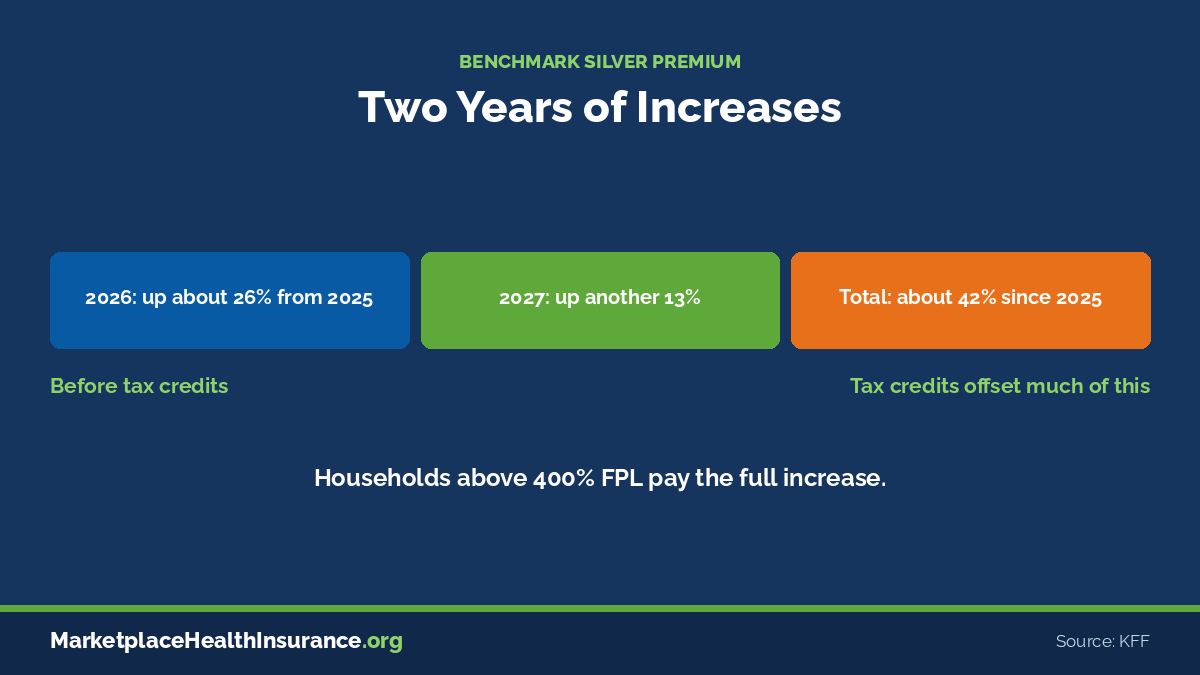
The Obamacare premium increase for 2027 is the second double-digit jump in a row. The average benchmark silver premium, the plan used to set tax credits, rose 13% for 2027 after climbing about 26% from 2025 to 2026. Over two years, that adds up to roughly a 42% increase in the price before savings.
Know your real 2027 price
See Your 2027 Premium After Savings
Enter your ZIP code to compare plans and see your estimated premium tax credit for 2027.
Plans, prices and savings vary by ZIP code, age, household size and income.
What you actually pay depends on your income, age, ZIP code and the plan you choose. This guide explains the numbers, the reasons behind them and the practical ways to bring your monthly bill down. To see real prices with your tax credit applied, compare 2027 Marketplace plans in your area.
The short answer
Benchmark silver premiums rose an average of 13% for 2027: about 11% in HealthCare.gov states and about 16% in states that run their own exchanges. People who qualify for a premium tax credit are shielded from much of the sticker increase, while households above 400% of the federal poverty level pay the full price.
How Much Obamacare Premiums Are Rising for 2027
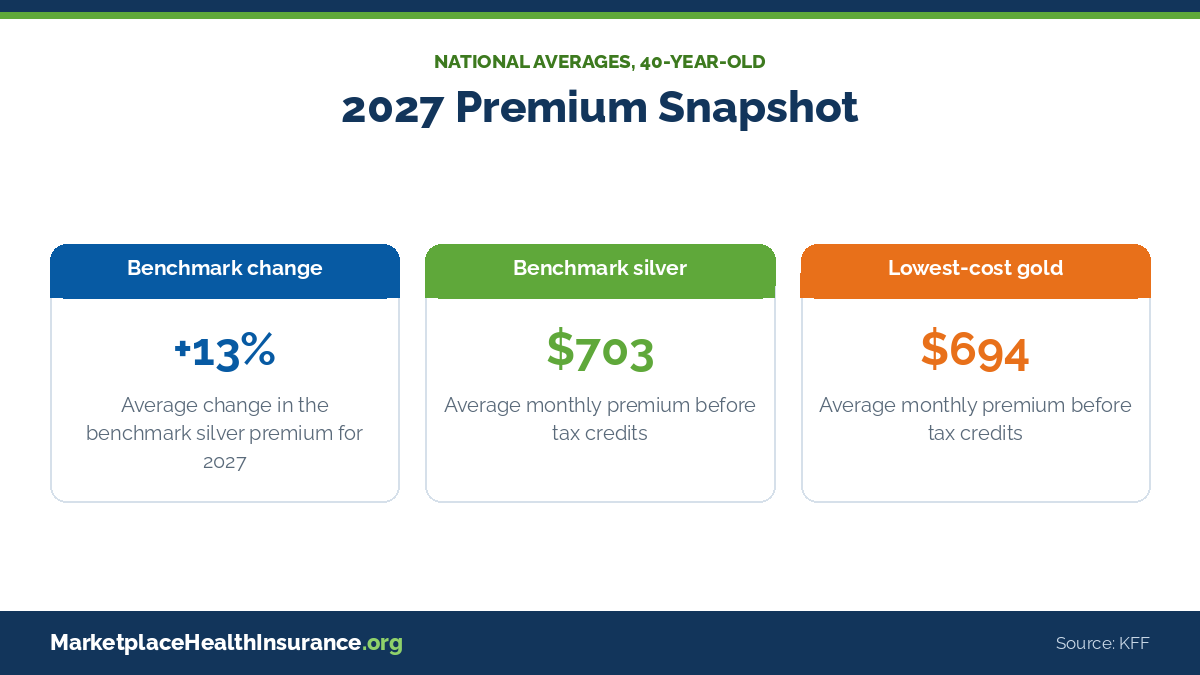
KFF’s review of 2027 rates shows prices rising again in nearly every part of the country. The numbers below are national averages for a 40-year-old before any premium tax credit is applied.
| 2027 measure | National figure |
|---|---|
| Average benchmark silver premium change | +13% |
| HealthCare.gov states | +11% |
| State-based marketplaces | +16% |
| Average benchmark silver, monthly | $703 |
| Lowest-cost silver, monthly | $681 |
| Lowest-cost gold, monthly | $694 |
| Median increase insurers proposed | 15% |
40-year-old, before tax credits. Sources: KFF, KFF/Peterson.
One detail stands out: the lowest-cost gold plan averages only slightly more than the benchmark silver plan. In some areas gold can even cost less than silver, so it pays to compare every metal level.
Why Premiums Went Up Again
Insurers set rates months before open enrollment, and their 2027 filings pointed to the same pressures.
Provider prices
Hospitals and physician groups negotiated higher payments, and those costs flow into premiums.
Inflation and labor shortages
Higher wages for nurses and other staff raise the cost of nearly every service.
Expired enhanced tax credits
The extra help that ended after 2025 led some healthier people to drop coverage.
A sicker risk pool
When healthier enrollees leave, the average cost of the people who remain goes up.
The tax credit change matters twice. It raises what many people pay directly, and it pushes up base premiums because insurers expect a smaller, higher-cost group of members.
Why some states rose faster than others
State-based marketplaces averaged a 16% benchmark increase, compared with about 11% in HealthCare.gov states. Local hospital prices, the number of insurers competing in a county, state reinsurance programs and changes in who stayed enrolled all play a part. Insurers’ median proposed increase across 276 companies in all 50 states and DC was 15%, so your own county can land well above or below the national average. The only reliable way to know your change is to compare the 2027 plans offered at your ZIP code.
Who Pays More and Who Is Protected
The premium tax credit limits what eligible households pay for the benchmark silver plan to a share of income. When the benchmark rises, the credit usually rises with it. That is why a 13% sticker increase does not mean a 13% bill increase for everyone.
More protected
✔
Households between 100% and 400% of the federal poverty level.
✔
People who choose the benchmark silver plan or a cheaper one.
✔
Enrollees at or below 250% of poverty who pick a silver plan with cost-sharing reductions.
More exposed
✕
Households above 400% of poverty, such as a family of four earning more than $132,000.
✕
Older enrollees above the cap, whose full-price premiums are highest.
✕
People who were on $0 plans under the enhanced credits.
Age also plays a role. Full-price premiums for older adults can be up to three times those of younger adults, so a 60-year-old above the subsidy cliff feels the same percentage increase as a much larger dollar amount. Below the cliff, the tax credit grows with the premium, which keeps the net cost tied to income rather than age.
Watch the subsidy cliff
Income just over 400% of the poverty level can mean losing the entire tax credit. For one person that line is $63,840 for 2027 coverage. Contributions to a pre-tax retirement account or health savings account may lower the income that counts.

From the agent’s desk
The renewal notice shows the new premium, but it rarely shows the cheaper alternatives. Families who compare plans with an updated income estimate often find a lower price at the same metal level or a gold plan that costs close to silver. Ten minutes of comparison can offset a large part of the 2027 increase.
Russell Noga, Licensed Insurance Agent
Income Limits for Premium Tax Credits
Tax credits for 2027 coverage use the 2026 federal poverty guidelines. These are the limits for the 48 contiguous states and DC; Alaska and Hawaii are higher.
| Household size | 100% FPL | 250% FPL | 400% FPL |
|---|---|---|---|
| 1 | $15,960 | $39,900 | $63,840 |
| 2 | $21,640 | $54,100 | $86,560 |
| 3 | $27,320 | $68,300 | $109,280 |
| 4 | $33,000 | $82,500 | $132,000 |
Source: HealthCare.gov. 250% FPL is the upper limit for cost-sharing reductions.
Because excess tax credit repayment caps were eliminated starting with the 2026 tax year, an income estimate that is too low can mean paying back the difference in full. For more on how subsidies work, see our Obamacare guide.
2027 Marketplace Plans
Call a Licensed Agent Now
A licensed agent can compare 2027 Marketplace plans in your ZIP code and check your premium tax credit at no cost.
TTY 711 · Mon–Fri 8am–8pm ET · No obligation to enroll
Ways to Lower Your 2027 Premium
1
Update your income and household size. A current estimate makes sure you get every dollar of tax credit you qualify for.
2
Shop instead of renewing. Your current plan may no longer be the best value. Compare at least three options.
3
Look at gold and bronze, not just silver. Pricing quirks can make gold a strong value, while bronze offers the lowest premium.
4
Use cost-sharing reductions if eligible. At or below 250% of poverty, a silver plan can come with much lower deductibles.
5
Check every insurer in your ZIP code. Carriers entered and exited states for 2027, so the cheapest option may be new to you.
See the full list of Marketplace health insurance companies and our affordable health insurance guide for more cost-saving ideas.
Deadlines to Lock In a 2027 Plan
In HealthCare.gov states, open enrollment runs November 1, 2026 through January 15, 2027. Choose a plan by December 15 for coverage starting January 1. Some state exchanges stay open longer, so check the open enrollment dates by state.
Before you pick a plan
- ✔Review your 2027 renewal notice and new premium.
- ✔Confirm your tax credit with an updated income estimate.
- ✔Compare total yearly cost: premium plus likely deductible.
- ✔Check that your doctors and prescriptions are covered.
- ✔Pay the first premium so coverage starts on time.
Deadline: December 15
Shop Before Your Plan Renews at a Higher Price
Compare 2027 plans now so you are not automatically renewed into a costlier option.
Plans, prices and savings vary by ZIP code, age, household size and income.
Obamacare Premium Increase 2027 FAQs
➤ How much are Obamacare premiums going up in 2027?
The average benchmark silver premium increased 13% for 2027, about 11% in HealthCare.gov states and about 16% in state-based marketplaces. Individual changes vary by insurer, plan and location.
➤ Why is my 2027 premium so much higher?
Insurers cite higher provider prices, inflation, labor shortages and a sicker risk pool after the enhanced premium tax credits expired at the end of 2025.
➤ Will my tax credit cover the increase?
If your income is between 100% and 400% of the federal poverty level, your credit generally rises when the benchmark premium rises, which offsets much of the increase on the benchmark plan.
➤ What is the average Obamacare premium in 2027?
KFF puts the national average benchmark silver premium at $703 a month for a 40-year-old before tax credits. The lowest-cost silver averages $681 and the lowest-cost gold $694.
➤ Is there a subsidy cliff in 2027?
Yes. With the enhanced credits expired, households above 400% of the poverty level do not qualify for a premium tax credit. That is $63,840 for one person and $132,000 for a family of four.
➤ How can I lower my Obamacare premium in 2027?
Update your income estimate, compare every metal level, check all insurers in your area and consider a silver plan with cost-sharing reductions if your income qualifies.
➤ Will my insurer still offer plans in 2027?
Most will, but some carriers left individual markets for 2027, including Cigna in all 11 of its states. If your insurer left, choose a new plan during open enrollment so you are not without coverage on January 1.
Free Plan Comparison
Call a Licensed Agent Now
Compare 2027 Marketplace plans and savings with a licensed agent in one call.
TTY 711 · Mon–Fri 8am–8pm ET · No obligation to enroll
About the Author: Russell Noga
Russell Noga is a licensed insurance agent and the founder of ZRN Health & Financial Services, LLC. He has helped people compare health and supplemental insurance for more than 16 years and reviews every page on MarketplaceHealthInsurance.org before it is published.
MarketplaceHealthInsurance.org is privately owned and operated by ZRN Health & Financial Services, LLC, based in Austin, Texas. We are not HealthCare.gov or any state exchange and are not connected with or endorsed by any government agency. Premiums, subsidies and plan availability vary by state, ZIP code, age, household size and income. Calls may be answered by a licensed insurance agent from a partner agency.