


Reviewed by Russell Noga, Licensed Insurance Agent · Updated November 19, 2026
Alternatives to Obamacare 2027 are getting a lot more attention this year. The enhanced premium tax credits expired at the end of 2025, the average benchmark silver premium rose another 13% for 2027, and households earning more than 400% of the federal poverty level no longer get any premium tax credit. For some families, a Marketplace plan now costs more than they can comfortably pay.
Check before you switch
See What a 2027 Marketplace Plan Costs You
Enter your ZIP code to compare plans and your estimated premium tax credit before you look at alternatives.
Plans, prices and savings vary by ZIP code, age, household size and income.
This guide walks through the real options outside the Marketplace, from Medicaid and job-based coverage to short-term plans and health care sharing ministries. Each one is compared on the same questions: does it cover pre-existing conditions, does it protect you from a large bill, and who can actually get it. Before you rule out the Marketplace, it is worth checking your savings, so you can also compare Marketplace plans in your ZIP code side by side with these alternatives.
The short answer
The main alternatives to Obamacare in 2027 are Medicaid or CHIP, coverage through your job or a spouse’s job, COBRA, Medicare if you qualify, short-term health plans, health care sharing ministries, and fixed indemnity or other limited plans. Only Medicaid, CHIP, job-based coverage, COBRA and Medicare give protection close to a Marketplace plan. The others cost less because they cover less.
Why People Are Looking for Alternatives to Obamacare in 2027
Three changes pushed Marketplace prices up for the 2027 plan year. Together they explain why so many shoppers are asking what else is out there.
What changed for 2027
+13%
Average benchmark silver premium change for 2027
$703
National average benchmark silver per month, age 40, before savings
400% FPL
Income limit for premium tax credits again
$86,560
400% FPL for a household of two (2027 coverage)
- The subsidy cliff returned. With the enhanced tax credits gone, a household above 400% of the federal poverty level pays the full premium, no matter how high it is.
- Premiums rose again. The benchmark silver premium went up roughly 26% from 2025 to 2026 and another 13% for 2027, about 42% over two years.
- Repayment caps ended. Starting with the 2026 tax year, there is no limit on how much excess premium tax credit you may owe back, which makes some shoppers nervous about estimating income.
None of this changes the core protections of Obamacare: plans still have to accept you regardless of health history and still cap your yearly out-of-pocket costs. That is the benchmark every alternative below should be measured against.
First Check: Do You Still Qualify for Help?
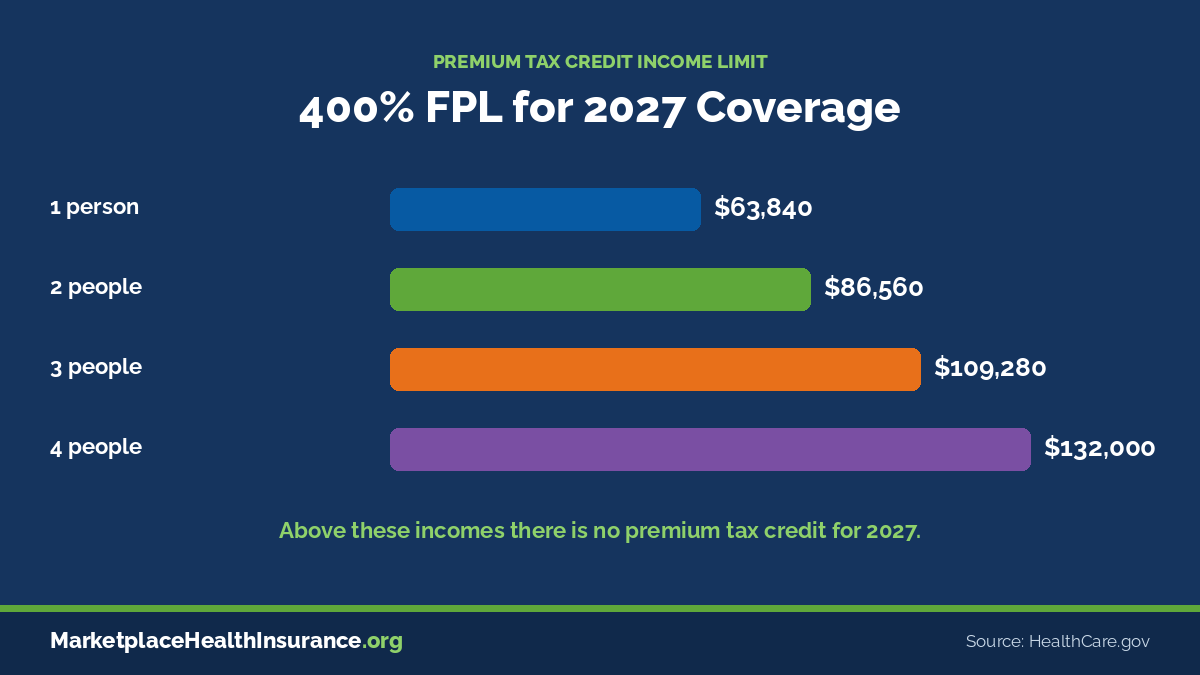
Many people assume they lost all help when the enhanced credits expired. That is only true above 400% of the federal poverty level. Below that line, the regular premium tax credit still applies, and it can be large in high-cost areas.
| Household size | 400% FPL limit for 2027 coverage | 250% FPL (silver cost-sharing help) |
|---|---|---|
| 1 | $63,840 | $39,900 |
| 2 | $86,560 | $54,100 |
| 3 | $109,280 | $68,300 |
| 4 | $132,000 | $82,500 |
Based on the 2026 federal poverty guidelines used for 2027 coverage in the 48 contiguous states and DC.
If your income falls under these limits, a Marketplace plan may cost far less than its sticker price, and a silver plan may include lower deductibles through cost-sharing reductions. Our affordable health insurance guide explains how to bring the monthly cost down before you give up the protections.
A lower income estimate is not a shortcut
Because repayment caps are gone, underestimating 2027 income to get a bigger tax credit can lead to a large bill at tax time. Use your best honest estimate and update it during the year if your income changes.
Alternatives That Offer Full Coverage
These options come closest to a Marketplace plan. They cover pre-existing conditions and offer broad benefits, but each has its own eligibility rules.
Medicaid and CHIP
Free or very low-cost coverage for lower-income adults, children and pregnant people. Eligibility depends on your state; in expansion states adults generally qualify up to 138% FPL, about $29,863 for two people.
Your job or a spouse’s job
Employer plans are often the best value. If a spouse’s employer offers family coverage, compare it against Marketplace pricing for the whole household.
COBRA
Lets you keep a former employer’s plan, usually for up to 18 months. You pay the full premium plus a small fee, so it is often expensive, but your doctors and deductible progress stay the same.
Medicare
If you are 65 or older, or qualify through disability, Medicare is usually the right path rather than a Marketplace plan.
Some employers now offer an individual coverage arrangement that reimburses you for a plan you buy yourself. If your employer offers one, the rules for combining it with Marketplace coverage are specific, so ask the plan administrator before enrolling.
Lower-Cost Alternatives and Their Trade-Offs
The options below usually cost less per month than an unsubsidized Marketplace plan. They are cheaper because they do not have to follow ACA rules.
| Option | Covers pre-existing conditions? | Main risk |
|---|---|---|
| Short-term health plan | Usually not | Claims for prior conditions can be denied; coverage length is limited and some states ban these plans |
| Health care sharing ministry | Often limited or with waiting periods | Not insurance; payment of your bills is not guaranteed |
| Fixed indemnity plan | Varies | Pays a set dollar amount per service, which may be far below the real bill |
| Catastrophic Marketplace plan | Yes | Only for people under 30 or with a hardship exemption; very high deductible |
| Direct primary care membership | Yes, for primary care only | Does not cover hospital stays, surgery or specialists |
Rules and availability vary by state. Read the plan documents before you buy.
Why some people choose them
✔
Lower monthly cost for healthy people
✔
Can be bought outside open enrollment in many cases
✔
Useful as a short bridge between jobs
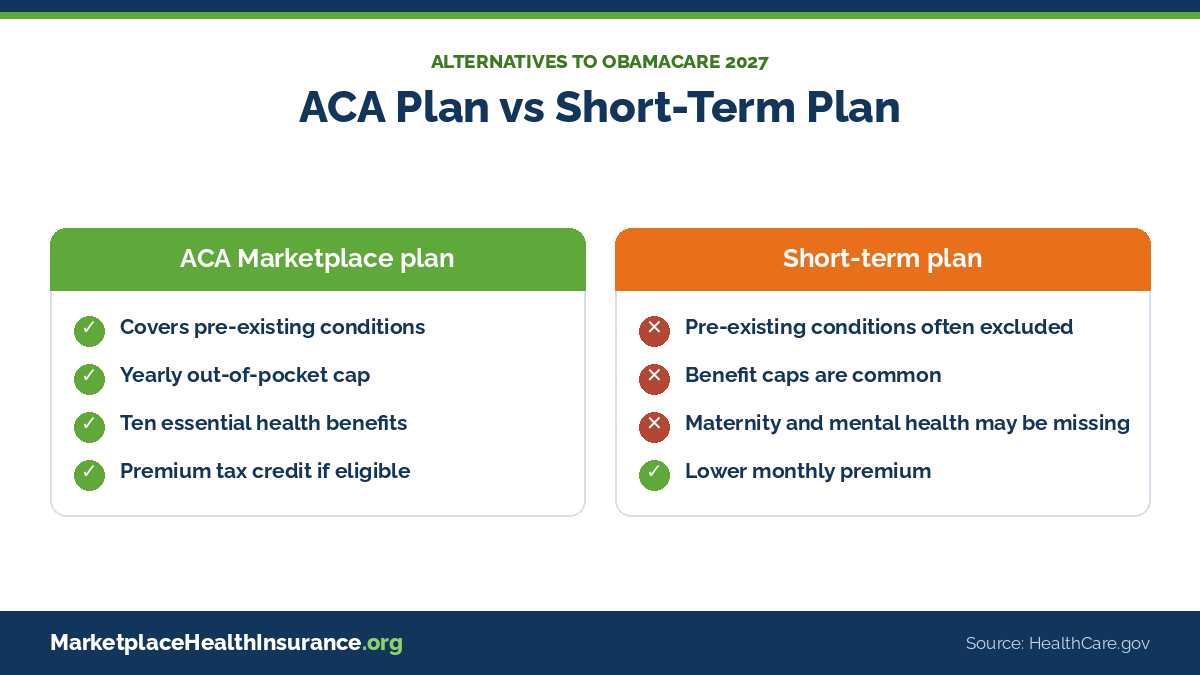
What can go wrong
✕
No guarantee a pre-existing condition will be covered
✕
Benefit limits can leave you with a large bill after a serious illness
✕
Missing essential benefits such as maternity or mental health care
✕
Leaving the Marketplace may mean waiting until the next open enrollment to return

From the agent’s desk
Shoppers who drop a Marketplace plan for a short-term policy often discover the trade-off only when they file a claim. The cheaper plan works well for a healthy person with a clear end date, such as a gap before a new job. For anyone with ongoing care, the monthly savings rarely make up for the risk of a denied claim.
Russell Noga, Licensed Insurance Agent
How to Compare Obamacare With an Alternative
1
Price your Marketplace plan first. Get a quote with your 2027 income and household size so you know the real cost after any tax credit.
2
List your health needs. Write down your doctors, prescriptions and any ongoing conditions. These decide whether a limited plan is risky for you.
3
Read the exclusions. For any non-ACA option, look for pre-existing condition rules, waiting periods and dollar caps on benefits.
4
Estimate a bad year. Compare what each option would cost if you needed a hospital stay. The Marketplace caps your yearly out-of-pocket costs; many alternatives do not.
5
Check the calendar. Marketplace enrollment for 2027 coverage ends January 15, 2027 in HealthCare.gov states. After that, you generally need a qualifying life event to get back in.
The Marketplace open enrollment guide lists every 2027 deadline, including states that stay open later.
2027 Marketplace Plans
Call a Licensed Agent Now
A licensed agent can compare 2027 Marketplace plans in your ZIP code and check your premium tax credit at no cost.
TTY 711 · Mon–Fri 8am–8pm ET · No obligation to enroll
Who Should Think Twice Before Leaving the Marketplace
Stay with an ACA plan if any of these apply
- ✔You have a chronic condition, take regular prescriptions or see a specialist.
- ✔You are pregnant or planning to be in 2027.
- ✔Your income is under 400% FPL and you qualify for a premium tax credit.
- ✔Your income is under 250% FPL and a silver plan would lower your deductible.
- ✔You could not afford a large hospital bill if a limited plan refused to pay.
For a broader look at how ACA plans work and what they must cover, see our ACA insurance overview and the main health insurance marketplace guide.
Weigh every option
Compare Marketplace Plans Against Your Alternatives
See 2027 premiums, deductibles and networks in your area so you know exactly what you would be giving up.
Plans, prices and savings vary by ZIP code, age, household size and income.
Alternatives to Obamacare 2027 FAQs
➤ What are the best alternatives to Obamacare in 2027?
The strongest alternatives are Medicaid or CHIP if you qualify, a job-based plan through you or your spouse, COBRA, and Medicare if you are eligible. Short-term plans, sharing ministries and fixed indemnity plans cost less but cover far less.
➤ Are short-term health plans a good replacement for an ACA plan?
They can work as a temporary bridge for healthy people, but they usually do not cover pre-existing conditions, can cap benefits and are limited or banned in some states.
➤ Is a health care sharing ministry insurance?
No. Members share medical bills under the ministry’s guidelines, but payment is not guaranteed and the arrangement is not regulated as insurance.
➤ Can I still get a subsidy for 2027?
Yes, if your household income is between 100% and 400% of the federal poverty level. For 2027 coverage, 400% FPL is $63,840 for one person and $86,560 for two.
➤ Who can buy a catastrophic plan?
Catastrophic Marketplace plans are available to people under 30 and to people who qualify for a hardship exemption. They cover essential benefits but have very high deductibles.
➤ What happens if I skip coverage in 2027?
There is no federal tax penalty, though a few states have their own mandate. The bigger risk is facing a large medical bill with no plan, and you may have to wait until the next open enrollment to buy one.
Free Plan Comparison
Call a Licensed Agent Now
Compare 2027 Marketplace plans and savings with a licensed agent in one call.
TTY 711 · Mon–Fri 8am–8pm ET · No obligation to enroll
About the Author: Russell Noga
Russell Noga is a licensed insurance agent and the founder of ZRN Health & Financial Services, LLC. He has helped people compare health and supplemental insurance for more than 16 years and reviews every page on MarketplaceHealthInsurance.org before it is published.
MarketplaceHealthInsurance.org is privately owned and operated by ZRN Health & Financial Services, LLC, based in Austin, Texas. We are not HealthCare.gov or any state exchange and are not connected with or endorsed by any government agency. Premiums, subsidies and plan availability vary by state, ZIP code, age, household size and income. Calls may be answered by a licensed insurance agent from a partner agency.