


Reviewed by Russell Noga, Licensed Insurance Agent · Updated November 19, 2026
ACA health insurance 2027 refers to the individual and family plans sold under the Affordable Care Act, mostly through HealthCare.gov and state-run exchanges. Every one of these plans has to accept you regardless of your health history and cover the same core set of benefits. What changes from year to year is the price, the insurers in your area and how much help you get paying for it.
2027 ACA plans are live
Compare ACA Health Insurance Plans in Your ZIP Code
See 2027 premiums, deductibles and networks, plus your estimated premium tax credit.
Plans, prices and savings vary by ZIP code, age, household size and income.
For 2027, prices are higher and the subsidy rules are tighter than in recent years. This page covers what an ACA plan includes, what it costs before and after savings, how the four metal levels split costs, who qualifies for a premium tax credit and when to enroll. If you want a basic definition first, start with what ACA insurance is. To see real plans and prices, compare ACA plans in your ZIP code.
The short answer
ACA health insurance 2027 plans cover ten essential health benefits and pre-existing conditions. The national average benchmark silver premium is $703 a month for a 40-year-old before savings, up 13% from last year. Premium tax credits are available for household incomes from 100% to 400% of the federal poverty level, and open enrollment runs November 1, 2026 to January 15, 2027 on HealthCare.gov.
ACA Health Insurance 2027 at a Glance
The 2027 plan year
$703
National average benchmark silver, per month at age 40, before savings
+13%
Average benchmark premium change for 2027
100% to 400% FPL
Income range for a premium tax credit
Dec 15, 2026
Deadline for coverage starting January 1, 2027
ACA plans are sold on the health insurance marketplace in every state. About 20 states and DC run their own exchange; the rest use HealthCare.gov. The rules about coverage and subsidies are the same in both.
What ACA Health Insurance Covers
Every ACA-compliant plan, from the cheapest bronze to platinum, must include the ten essential health benefits. The metal level changes how costs are shared, not what is covered.
Doctor and hospital care
Outpatient visits, emergency services and inpatient hospital stays.
Maternity and newborn care
Prenatal visits, delivery and care for the baby after birth.
Mental health and substance use
Counseling, therapy and treatment, covered on the same footing as physical care.
Prescription drugs
Each plan has a drug list, so check that yours are on it.
Preventive care
Screenings, vaccines and annual checkups, usually at no cost in network.
Children’s care
Pediatric services, including dental and vision care for kids.
- Pre-existing conditions are covered. Insurers cannot deny you or charge more because of your health history.
- No lifetime or yearly dollar caps on essential health benefits.
- A yearly out-of-pocket maximum limits what you pay for covered in-network care.
- Also included: rehabilitative and habilitative services, lab tests, and prevention and chronic disease management.
What ACA Health Insurance Costs in 2027
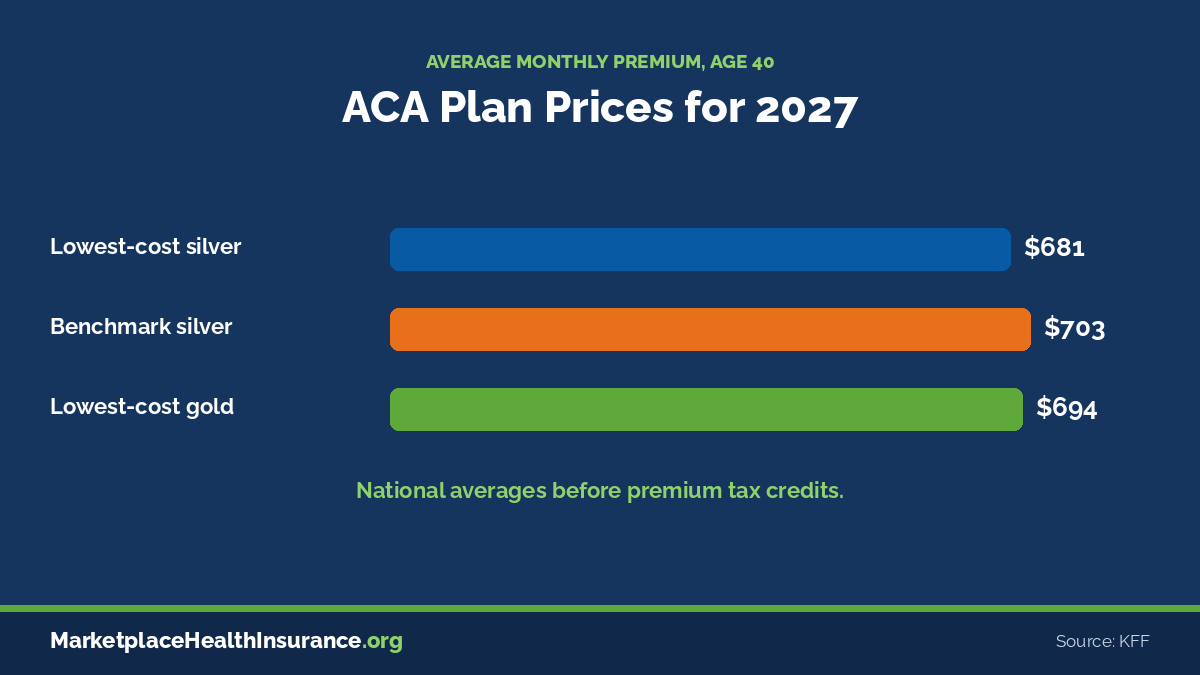
Prices are set by ZIP code, age, tobacco use and plan. The national averages below are for a 40-year-old before any premium tax credit.
| Plan | Average monthly premium, age 40 |
|---|---|
| Lowest-cost silver | $681 |
| Benchmark silver (second-lowest-cost silver) | $703 |
| Lowest-cost gold | $694 |
Source: KFF. Your price depends on where you live and your age.
The benchmark premium rose 13% for 2027, about 11% in HealthCare.gov states and 16% in state-based exchanges. That follows a jump of about 26% from 2025 to 2026. Insurers point to higher provider prices, inflation, staffing costs and a sicker risk pool after the enhanced premium tax credits ended. Our why health insurance is going up in 2027 guide explains each cause.
Gold can cost about the same as silver
Nationally, the lowest-cost gold plan averages only a few dollars more per month than the benchmark silver plan. In some areas gold is the better value because it carries a lower deductible, so compare both before choosing.

From the agent’s desk
The coverage rules are identical from plan to plan, so the real differences come down to three things: the network, the drug list and the total yearly cost. A plan that saves a little each month can cost far more by December if a regular doctor is out of network.
Russell Noga, Licensed Insurance Agent
Metal Levels and How Costs Are Shared
Metal levels describe how much of the average person’s covered costs the plan pays. Lower metal levels usually mean lower premiums and higher deductibles.
| Metal level | Plan pays on average | Best for |
|---|---|---|
| Bronze | About 60% | Healthy people who mainly want protection from big bills |
| Silver | About 70%, more with cost-sharing reductions | Incomes at or below 250% FPL, or moderate care needs |
| Gold | About 80% | People who expect regular care or prescriptions |
| Platinum | About 90% | Heavy users of care, where offered |
| Catastrophic | Very high deductible | People under 30 or with certain hardship exemptions |
Percentages are averages across all enrollees, not a promise for any single bill.
Comparing the total yearly cost, meaning 12 months of premiums plus the deductible you could realistically hit, is a better test than the monthly premium alone.
Premium Tax Credits for ACA Insurance in 2027
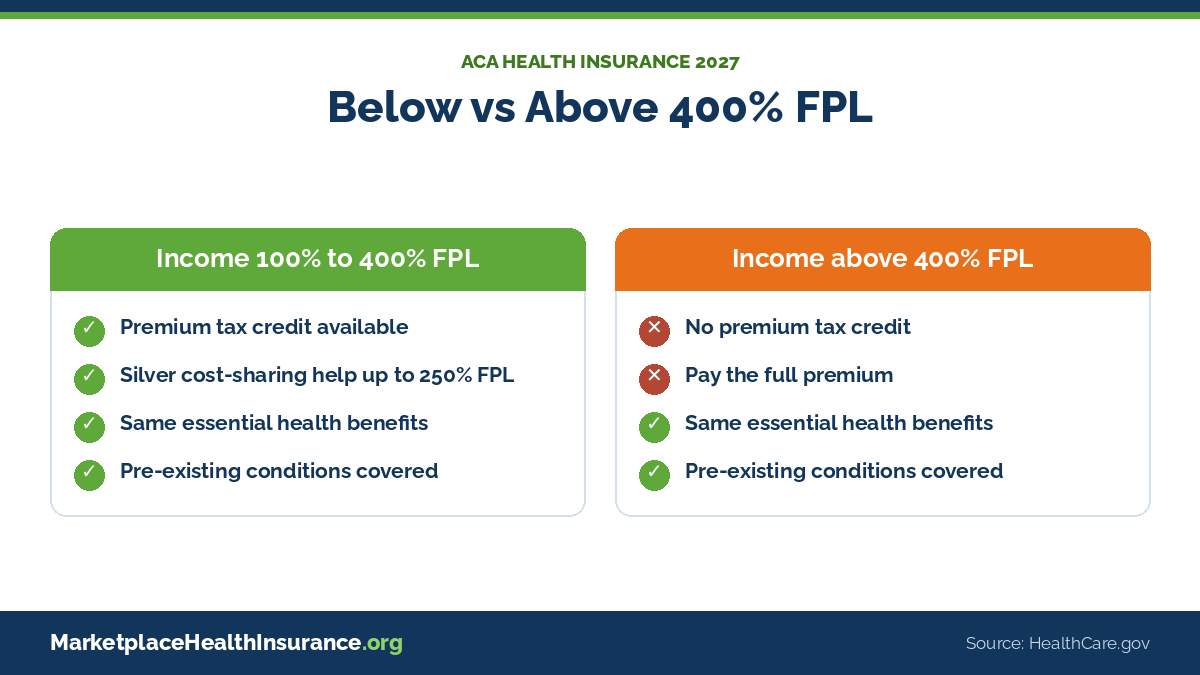
The enhanced credits that applied from 2021 through 2025 have expired. For 2027, the original rules apply: you may qualify for a premium tax credit if your household income is between 100% and 400% of the federal poverty level and you do not have access to other affordable coverage.
| Household size | 100% FPL | 250% FPL (cost-sharing reductions) | 400% FPL (credit ends) |
|---|---|---|---|
| 1 | $15,960 | $39,900 | $63,840 |
| 2 | $21,640 | $54,100 | $86,560 |
| 3 | $27,320 | $68,300 | $109,280 |
| 4 | $33,000 | $82,500 | $132,000 |
2026 poverty guidelines, used for 2027 coverage in the 48 contiguous states and DC.
Above 400% FPL there is no credit, which is often called the subsidy cliff. Starting with the 2026 tax year there is also no cap on repaying excess credits, so estimate your 2027 income carefully. Details are in our Obamacare subsidies 2027 guide.
2027 Marketplace Plans
Call a Licensed Agent Now
A licensed agent can compare 2027 Marketplace plans in your ZIP code and check your premium tax credit at no cost.
TTY 711 · Mon–Fri 8am–8pm ET · No obligation to enroll
Who Can Buy ACA Health Insurance
Basic eligibility
- ✔You live in the state where you apply.
- ✔You are a U.S. citizen, national or lawfully present immigrant.
- ✔You are not incarcerated.
- ✔You are not enrolled in Medicare.
Buying a plan and getting help paying for it are separate questions. For 2027, premium tax credits for immigrants are limited to lawful permanent residents, Cuban and Haitian entrants and COFA residents. Refugees and asylees can still buy a plan at full price. People denied or removed from Medicaid solely for not meeting work requirements are also not eligible for a premium tax credit starting in 2027.
If your job offers affordable coverage, you generally will not qualify for a credit on the Marketplace. For the bigger picture on the law itself, see Obamacare 2027.
How and When to Enroll in an ACA Plan
1
Check your dates. On HealthCare.gov, open enrollment runs November 1, 2026 through January 15, 2027. Several state exchanges close later.
2
Estimate 2027 income. Your credit is based on expected 2027 household income.
3
Compare plans and insurers. Look at premiums, deductibles, networks and drug lists side by side.
4
Pick by December 15, 2026. That gives you coverage starting January 1, 2027. Plans chosen December 16 through January 15 start February 1.
5
Pay the first premium. Coverage starts only after the insurer receives your first payment.
Insurers change every year. For 2027, Cigna is leaving the individual market in all 11 of its states, and other companies exited or entered specific states. See which carriers sell where in our Marketplace health insurance companies guide.
Choose by December 15
Start Your ACA Coverage on January 1, 2027
Enter your ZIP code to compare plans and savings before the deadline.
Plans, prices and savings vary by ZIP code, age, household size and income.
ACA Health Insurance 2027 FAQs
➤ What does ACA health insurance cover in 2027?
Every ACA plan covers the ten essential health benefits, including doctor visits, hospital care, emergency services, maternity care, mental health care, prescription drugs, preventive care and pediatric services. Pre-existing conditions are covered.
➤ How much does ACA health insurance cost in 2027?
The national average benchmark silver premium is $703 a month for a 40-year-old before savings. Your cost depends on your ZIP code, age, plan and income, and many people pay less after a premium tax credit.
➤ Who qualifies for ACA subsidies in 2027?
Households with income between 100% and 400% of the federal poverty level may qualify for a premium tax credit if they lack other affordable coverage. For 2027 coverage, 400% FPL is $63,840 for one person and $132,000 for a family of four.
➤ Is ACA insurance the same as Obamacare?
Yes. Obamacare is the common name for the Affordable Care Act, and ACA insurance and Obamacare plans are the same Marketplace plans.
➤ When can I enroll in ACA health insurance for 2027?
Open enrollment on HealthCare.gov runs November 1, 2026 through January 15, 2027. Choose by December 15, 2026 for a January 1 start. Outside that window you need a qualifying life event.
➤ Did ACA premiums go up for 2027?
Yes. The average benchmark silver premium rose 13% for 2027, after an increase of about 26% from 2025 to 2026.
Free Plan Comparison
Call a Licensed Agent Now
Compare 2027 Marketplace plans and savings with a licensed agent in one call.
TTY 711 · Mon–Fri 8am–8pm ET · No obligation to enroll
About the Author: Russell Noga
Russell Noga is a licensed insurance agent and the founder of ZRN Health & Financial Services, LLC. He has helped people compare health and supplemental insurance for more than 16 years and reviews every page on MarketplaceHealthInsurance.org before it is published.
MarketplaceHealthInsurance.org is privately owned and operated by ZRN Health & Financial Services, LLC, based in Austin, Texas. We are not HealthCare.gov or any state exchange and are not connected with or endorsed by any government agency. Premiums, subsidies and plan availability vary by state, ZIP code, age, household size and income. Calls may be answered by a licensed insurance agent from a partner agency.